Architecture for agents that know what they know — and can show how. A practitioner's point of view on agent-ready enterprise knowledge, tested against a life sciences enterprise.
Every enterprise now has access to capable models. What separates them is what their agents know — and whether anyone can tell how far to trust it.
In From Data to Intelligence we argued that thirty years of business intelligence built sophisticated infrastructure for moving and presenting data, but never built organizational intelligence — and that AI deployed on that foundation amplifies the disintegration rather than curing it. This point of view takes the next step. It asks what an enterprise must actually give its agents so they can reason, recommend and act safely.
Most enterprises give agents three things that look like knowledge and are not. Data in systems and lakes records what happened, but not what it means. Information in documents and wikis holds meaning, but untyped, unowned and unversioned. And parametric memory — whatever the model absorbed in training — answers fluently on behalf of an organization it has never met. Agents built on these produce confident answers in which a fact, an estimate, a policy and a guess all sound the same.
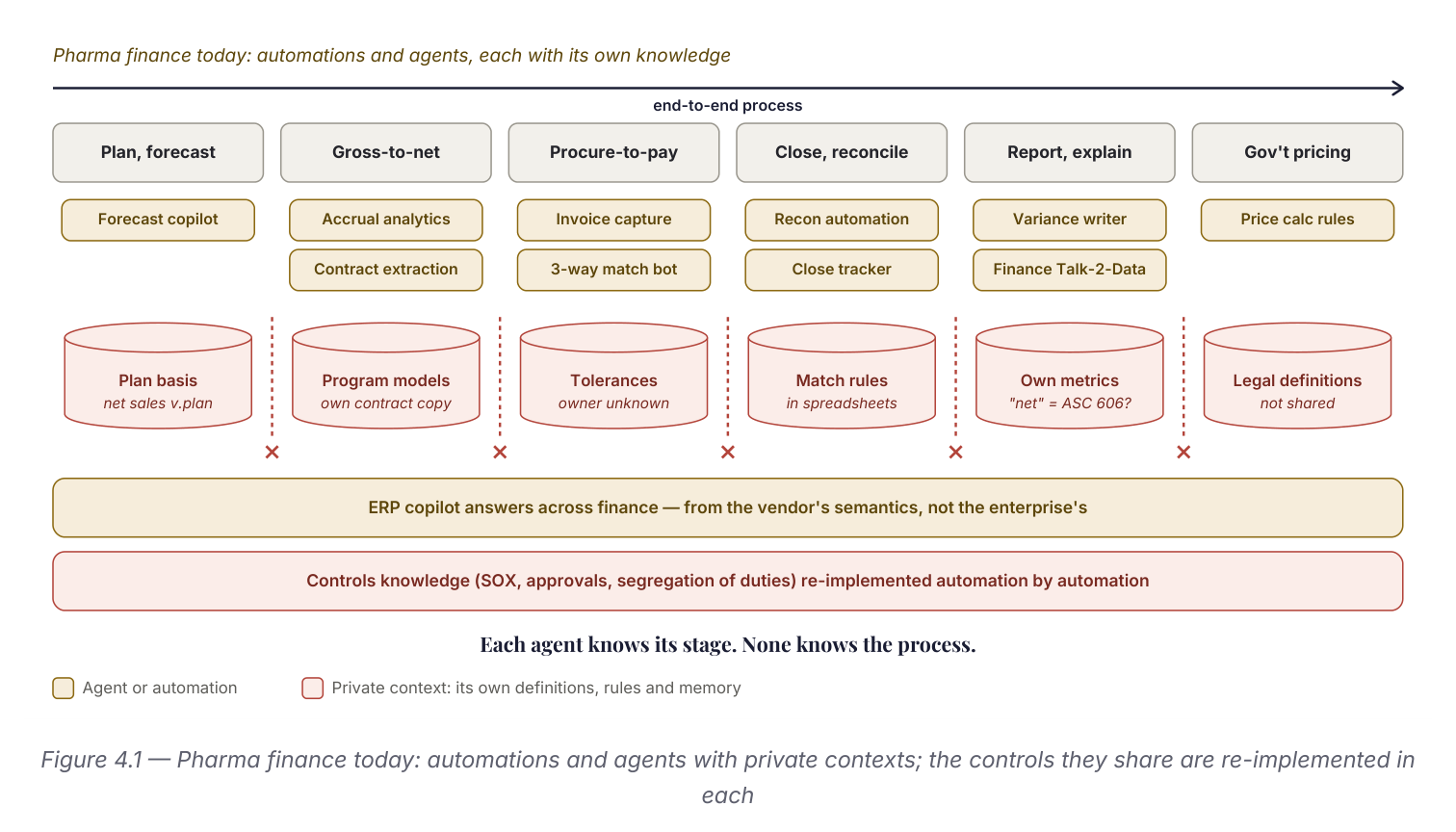
Pharma commercial and finance teams are already building agents: content generation, next-best-action agents in Veeva and Salesforce, email intelligence, Talk-2-Data analytics, invoice and close automation, variance commentary. Each is a sensible investment. But most are Siloed Agents — purpose-built agents whose definitions, rules, context and memory live inside their own harness. Each knows its stage; none knows the process. Played forward, a siloed estate plateaus on accuracy, relevance and efficiency, every new purpose-led agent costs more than the last, and the organization builds a shadow context layer as hard to unwind as the shadow semantic layer of the BI era. The answer is not fewer agents. It is end-to-end, enterprise-grade knowledge that every agent shares.
Knowledge, in the sense agents need, is typed, owned, governed, versioned and has a lifecycle. It is also bounded: transactional and master data stay in the systems of record, and the knowledge layer only defines, governs, predicts, advises on or explains them. And it is decision-first: every knowledge object must serve at least one decision, or it is a candidate for retirement.
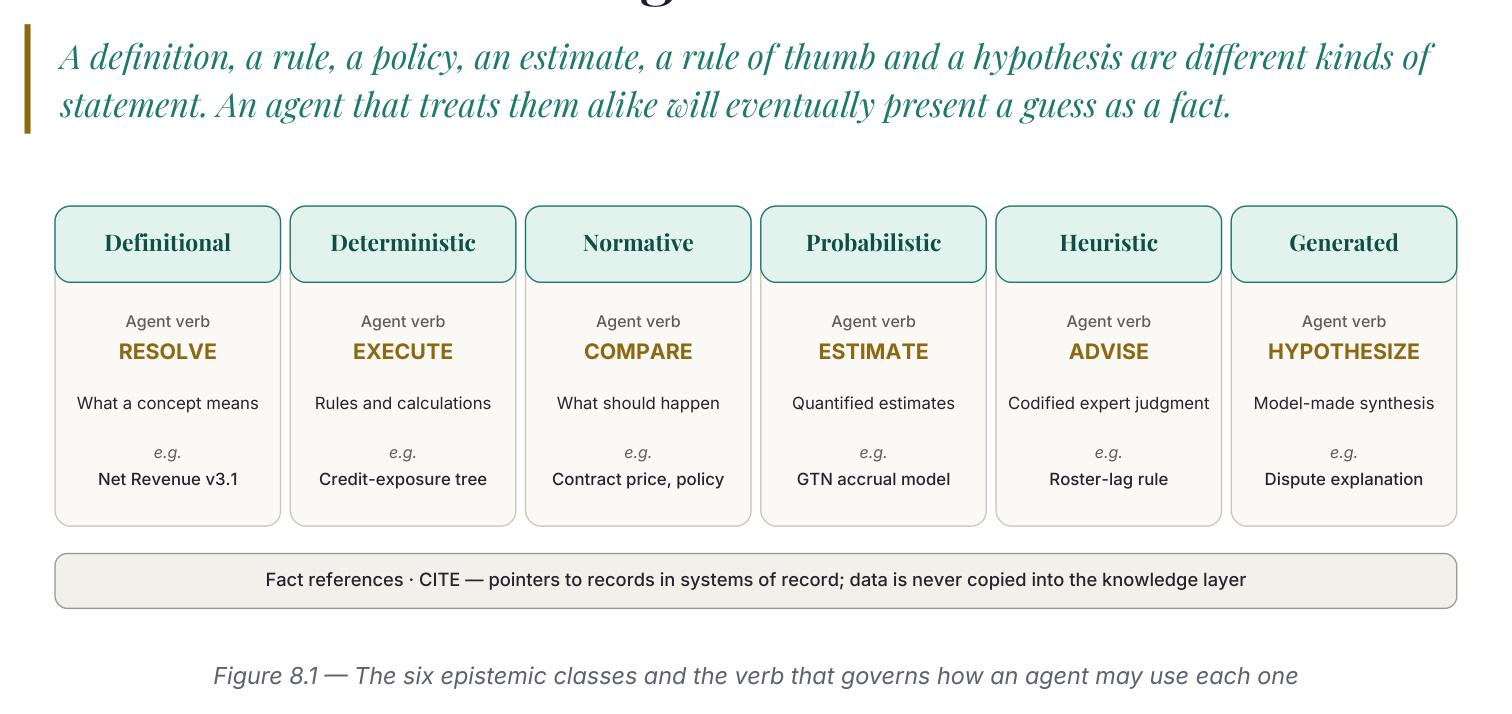
We distinguish six epistemic classes — definitional, deterministic, normative, probabilistic, heuristic and generated — plus fact references that point into systems of record. Each class has a verb that governs how an agent may use it: resolve a definition, execute a rule, compare against a policy, estimate with a model, advise from experience, hypothesize from synthesis. Every knowledge object carries an epistemic profile: its class; its origin (who or what authored it — a person, a system's configuration, a statistical model or AI — fixed for each version); its assurance (from A0 unverified to A4 formally validated, with an expiry date); and a treatment derived from all three, which owners may tighten but never loosen.
An agent should never present an estimate as a fact, a rule as a suggestion, or a guess as knowledge.
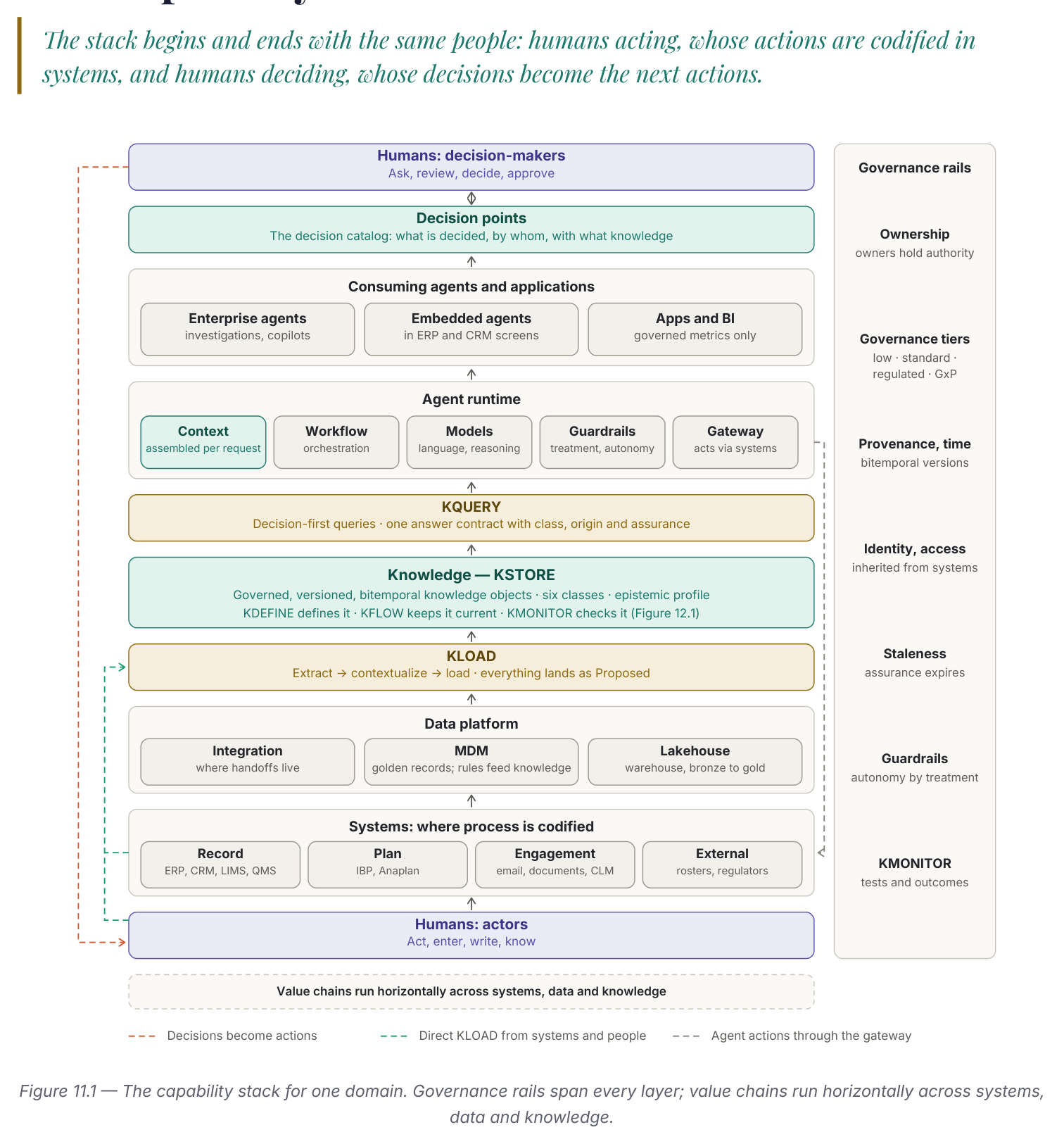
The architecture is a capability stack that runs from humans acting, through the systems where process is codified, the data platform, the knowledge layer and the agent runtime, to humans deciding — and loops back. Six components give it a working vocabulary: KDEFINE (define), KLOAD (extract, contextualize, load), KSTORE (store), KQUERY (query), KFLOW (govern and move) and KMONITOR (monitor). We lay the architecture out in nine steps and over seventy capabilities, from defining what valid knowledge is to monitoring whether decisions actually improved. Four rules hold it together: context is assembled at runtime and never stored as a layer; models supply language and reasoning, never enterprise facts; agents act through systems, never around them; and vendor-embedded agents consume enterprise knowledge or declare their limits.
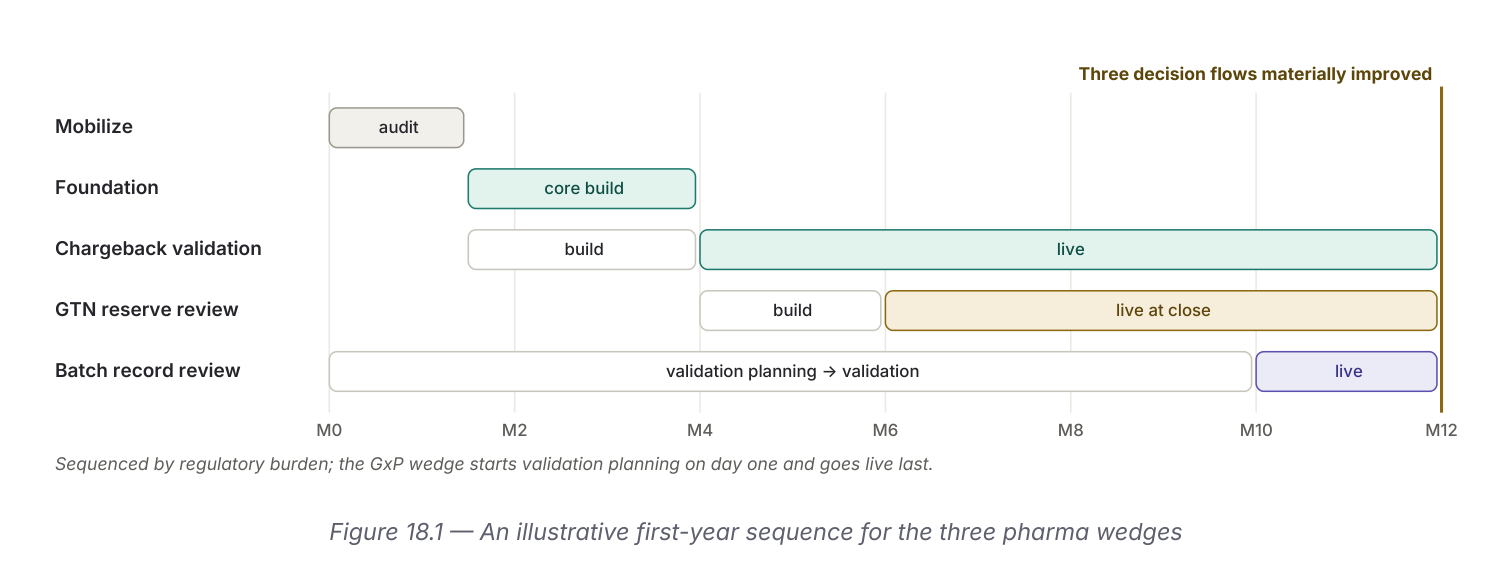
We test the model against three US pharma value chains. In order-to-cash, the people a manufacturer engages are mostly not the people who buy, and most of the knowledge sits in gross-to-net — where reported net revenue is partly an estimate. In plan-to-produce, "released" has at least four meanings, release is a human-only decision, and AI in GMP processes is itself under regulatory scrutiny. In record-to-report, one reported figure combines facts, rules, estimates and human judgment, all governed by accounting policy — and true-ups are where estimates are graded. Each value chain gets a first wedge: chargeback validation, batch record review by exception, and gross-to-net reserve review at month-end close.
The knowledge layer is not a better data lake, a richer catalog or a larger vector store. Data stores hold records; the knowledge layer holds statements about meaning, rules, expectations, estimates and judgment — with the trust record attached. Vendors now supply containers and interchange formats for meaning, and that is welcome. What no vendor can supply is the organization's own content, ownership with authority, and the discipline that tells an agent how far to trust each claim.
Do not launch a platform. Launch three decisions and build only what they need. Define before you load. Govern meaning, not data. Keep the model inside its boundary. And measure decisions, not usage — decision latency and outcomes are the evidence that matters most.
The guidebook diagnosed why thirty years of BI never produced intelligence. This point of view designs what the agent era needs instead.
From Data to Intelligence ended with an architecture — five layers, from a semantic knowledge graph to institutional memory capture — and a warning: the next three years will define the next thirty. Since publishing it, the question we hear most is a practical one: what exactly do we build, and how do we know it is working? At the same time, our March 2026 article Documents Are Not Knowledge argued that typed, purpose-built knowledge objects — not raw document retrieval — are the foundation agents need.
This point of view brings those threads together into one architecture. It defines what knowledge is in a form agents can use, how to classify and label it, how to architect the capabilities around it, and how the whole works in a heavily regulated industry. It is opinionated where our experience supports a view, and explicit where it does not.
The guidebook's five-layer Decision Intelligence Architecture remains the frame. This point of view makes it buildable: the semantic knowledge graph (Layer 1) becomes the knowledge layer's definitional spine; lineage and provenance (Layer 2) become the envelope and source registry; contextual intelligence (Layer 3) becomes heuristic, normative and generated knowledge objects; the agentic layer (Layer 4) becomes the runtime that consumes KQUERY; institutional memory (Layer 5) becomes versions, rationale and memory records. KSTORE, the knowledge store, is where the guidebook's Platinum layer — the semantic layer above Gold — becomes concrete, together with the stored knowledge its Diamond layer reasons with.
Chief Data and Analytics Officers deciding what to fund before agents go into production; enterprise and data architects who need a capability model above the data platform; finance, quality and commercial leaders in life sciences who will be asked to trust agent output; and AI governance and compliance teams who must decide what "trustworthy" means in practice.
Different readers can take different paths through the eighteen chapters:
| If you are… | Read | You will come away with |
|---|---|---|
| An executive or sponsor | Executive Summary; Ch. 1, 5–7, 15, 18 | The case, the core idea, what it means in your business, and how to start |
| An enterprise or data architect | Ch. 5–7; Parts III–IV; Appendices C, D, F | The knowledge model, the capability architecture and the specs to design against |
| A commercial, finance or quality leader | Ch. 3–7 and 15–16 | Your process today, where it lands, and what agents will show you on shared knowledge |
| In AI governance or compliance | Ch. 5, 9, 13 (Steps 7, 9), 16–17 | How trust, autonomy, validation and evidence are designed in |
Some claims here are grounded in repeated practitioner experience: that documents and data are not knowledge, that definitions fragment across systems, that ungoverned AI launders errors into confident answers. Others are proposals: the six-class model, the epistemic profile, the component vocabulary, the nine-step capability architecture and the wedges. These are our best-informed designs, tested so far in design work and early implementations, not peer-reviewed standards. Statements about regulation and vendor products reflect public sources as of October 2026 (Appendix E) and are moving quickly; verify them before relying on them. Figures in worked examples are illustrative. Nothing here is legal, regulatory or accounting advice.
Why agents built on data, documents and model memory cannot tell a fact from a guess
A dashboard shows a number and waits for a human to interpret it. An agent interprets the number itself, says what it means, and may act on it. Whatever is wrong underneath now travels further and faster.
The guidebook described how an LLM operating on a semantically disintegrated estate will pick one of seven revenue definitions and present it with full confidence — and how engineering errors that have run long enough to look intentional get learned as valid patterns. We called this error laundering. Agents raise the stakes in three ways. They chain steps, so an early mistake propagates through every later one. They synthesize across sources, so a figure from one system and a rule from another are combined without either owner knowing. And they act: they draft credit memos, recommend reserves, prepare batch dispositions.
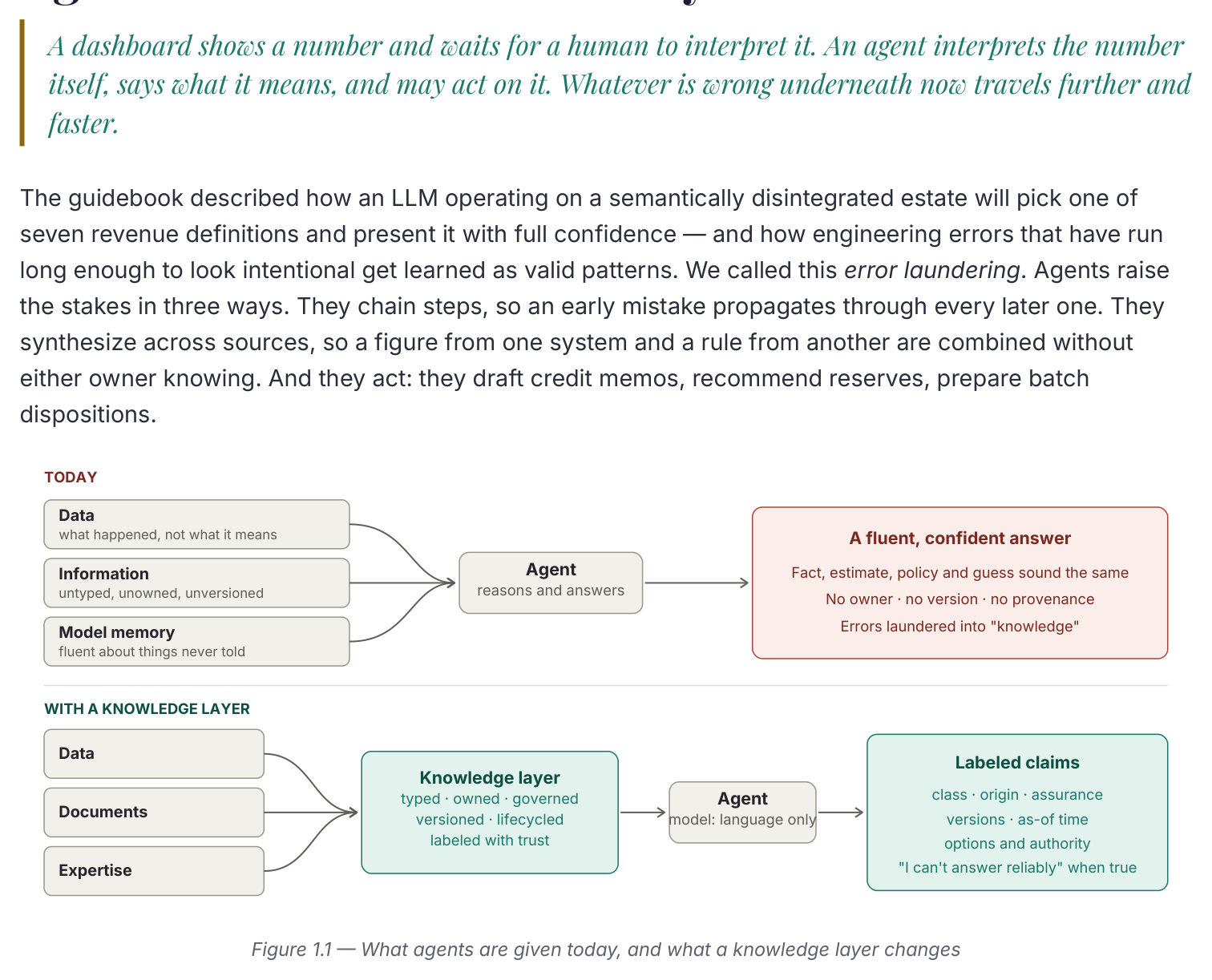
When enterprises connect agents to "their knowledge", they usually connect three things. None of them is knowledge in the sense an agent needs.
| What agents are given | What it actually is | What it lacks | What happens |
|---|---|---|---|
| Data | Records of what happened, in ERP, CRM, LIMS and the lakehouse | Meaning, ownership of meaning, the rules and intent behind the numbers | The agent returns numbers without knowing which definition they follow |
| Information | Documents, wikis, contracts, SOPs, email | Type, structure, versions, owners, a signal of whether it is current | The agent retrieves plausible passages, some of them superseded |
| Parametric memory | Whatever the model absorbed in training | Any connection to this organization, its policies or this year's rules | The agent answers fluently about things it was never told |
Agents built on those three sources fail in predictable ways. The first three were described in Documents Are Not Knowledge; the guidebook described the next two; the last becomes visible as agents move into production.
| Failure mode | What happens | What prevents it |
|---|---|---|
| Hallucination under retrieval pressure | The agent can't find a precise answer, so it generates a plausible one; in a workflow the error propagates | Typed knowledge objects with field-level answers; fail visibly when knowledge is missing |
| Persona blindness | Knowledge that is correct in general is wrong for this role, market or jurisdiction | Scope on every knowledge object; persona-aware resolution |
| Evidence collapse | The agent cannot say where an answer came from, so no one can verify or audit it | Provenance, versions and a context manifest on every answer |
| Error laundering | Inherited workarounds and defects are learned as valid business logic | Owned, validated rules; conflicts between intended and implemented behavior made visible |
| Definition roulette | One of several valid definitions is chosen silently ("net price", "released", "revenue") | Meaning resolution that disambiguates instead of guessing |
| Parametric bypass | The model answers from training — sometimes correctly — and the governed knowledge layer is never consulted | A model boundary: enterprise claims must be grounded in governed knowledge or be removed |
The last failure mode deserves emphasis because it is invisible. A model that "knows" the statutory Medicaid rebate rate will state it correctly today. When the rule changes, it will state the old one with the same confidence — and nobody will know the answer never came from a governed source. Correctness is not the test. Provenance is.
The common response is engineering: better chunking, better embeddings, bigger context windows, re-ranking. These help retrieval. They do not tell the agent whether a retrieved passage is a binding policy or someone's opinion, whether a number is an estimate or a fact, whether a rule is still in force, or who would stand behind any of it. Those are properties of knowledge, not of retrieval — and they have to be created, owned and maintained before an agent ever asks a question.
The quality of an agent's answers is bounded by the quality of what it knows. What it knows is bounded by whether the organization has turned data and information into governed knowledge — and labeled that knowledge with how far it can be trusted.
Information becomes knowledge only when it is shaped to a purpose, owned by someone with authority, and labeled with how far it can be trusted.
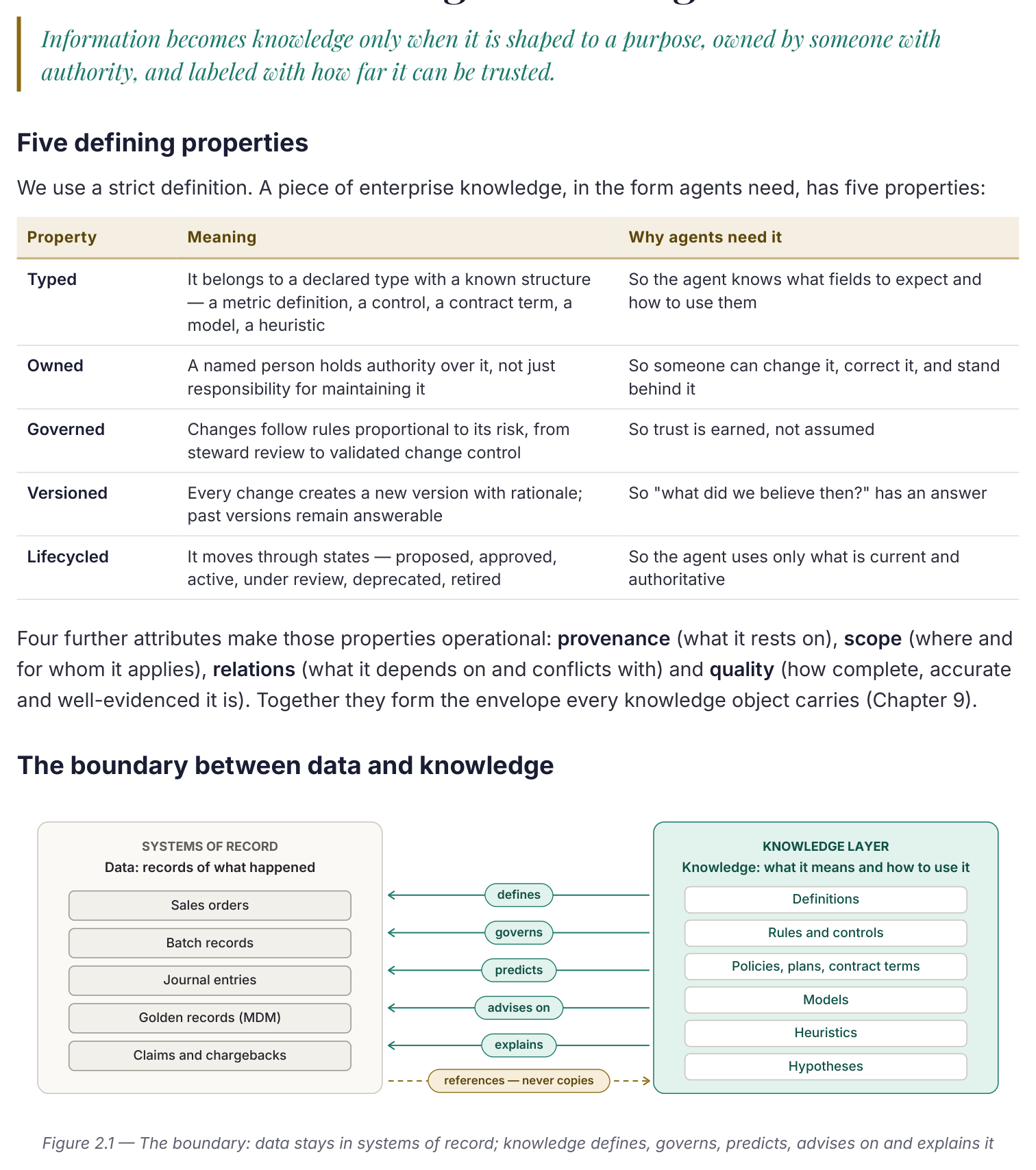
We use a strict definition. A piece of enterprise knowledge, in the form agents need, has five properties:
| Property | Meaning | Why agents need it |
|---|---|---|
| Typed | It belongs to a declared type with a known structure — a metric definition, a control, a contract term, a model, a heuristic | So the agent knows what fields to expect and how to use them |
| Owned | A named person holds authority over it, not just responsibility for maintaining it | So someone can change it, correct it, and stand behind it |
| Governed | Changes follow rules proportional to its risk, from steward review to validated change control | So trust is earned, not assumed |
| Versioned | Every change creates a new version with rationale; past versions remain answerable | So "what did we believe then?" has an answer |
| Lifecycled | It moves through states — proposed, approved, active, under review, deprecated, retired | So the agent uses only what is current and authoritative |
Four further attributes make those properties operational: provenance (what it rests on), scope (where and for whom it applies), relations (what it depends on and conflicts with) and quality (how complete, accurate and well-evidenced it is). Together they form the envelope every knowledge object carries (Chapter 9).

An architecture for knowledge must say what it does not hold. Without a boundary, a knowledge layer either becomes a second data warehouse or loses touch with the records insights depend on. Our rule is simple: transactional and master data stay in their systems of record. Knowledge objects define, govern, predict, advise on or explain that data, and reference it — they never copy it.
| Item | Data or knowledge | Why |
|---|---|---|
| A sales order, a batch record, a journal entry | Data | A record of an event |
| A customer golden record in MDM | Data (master) | A reconciled entity record |
| The pricing procedure configured in SAP | Knowledge — deterministic | Defines how a price is computed |
| MDM survivorship and match rules | Knowledge — deterministic | Decide which source wins: a business decision |
| The definition of net sales under ASC 606 | Knowledge — definitional | Defines meaning |
| The credit policy; a contract price | Knowledge — normative | States what should happen |
| A late-payment model | Knowledge — probabilistic | A governed predictor |
| That model's score for one customer today | Data (derived) | An output of knowledge, not knowledge itself |
| A collector's rule of thumb | Knowledge — heuristic | Codified expert judgment |
| An LLM's explanation of a payment dispute | Knowledge — generated | An unverified hypothesis |
The guidebook's central design principle was that intelligence should flow to decisions rather than decision-makers navigating to data. For the knowledge layer this becomes a hard rule: every knowledge object must be traceable to at least one decision it informs. A knowledge object that informs no decision is a candidate for retirement. The rule keeps the layer small and precise, gives governance a reason to exist, and prevents the most common failure of knowledge programs — cataloging everything and serving nothing.
Which decision does it serve? If none, don't load it. Who has authority over it? If no one, it isn't ready. How should an agent treat it? If you can't say, it isn't classified yet.
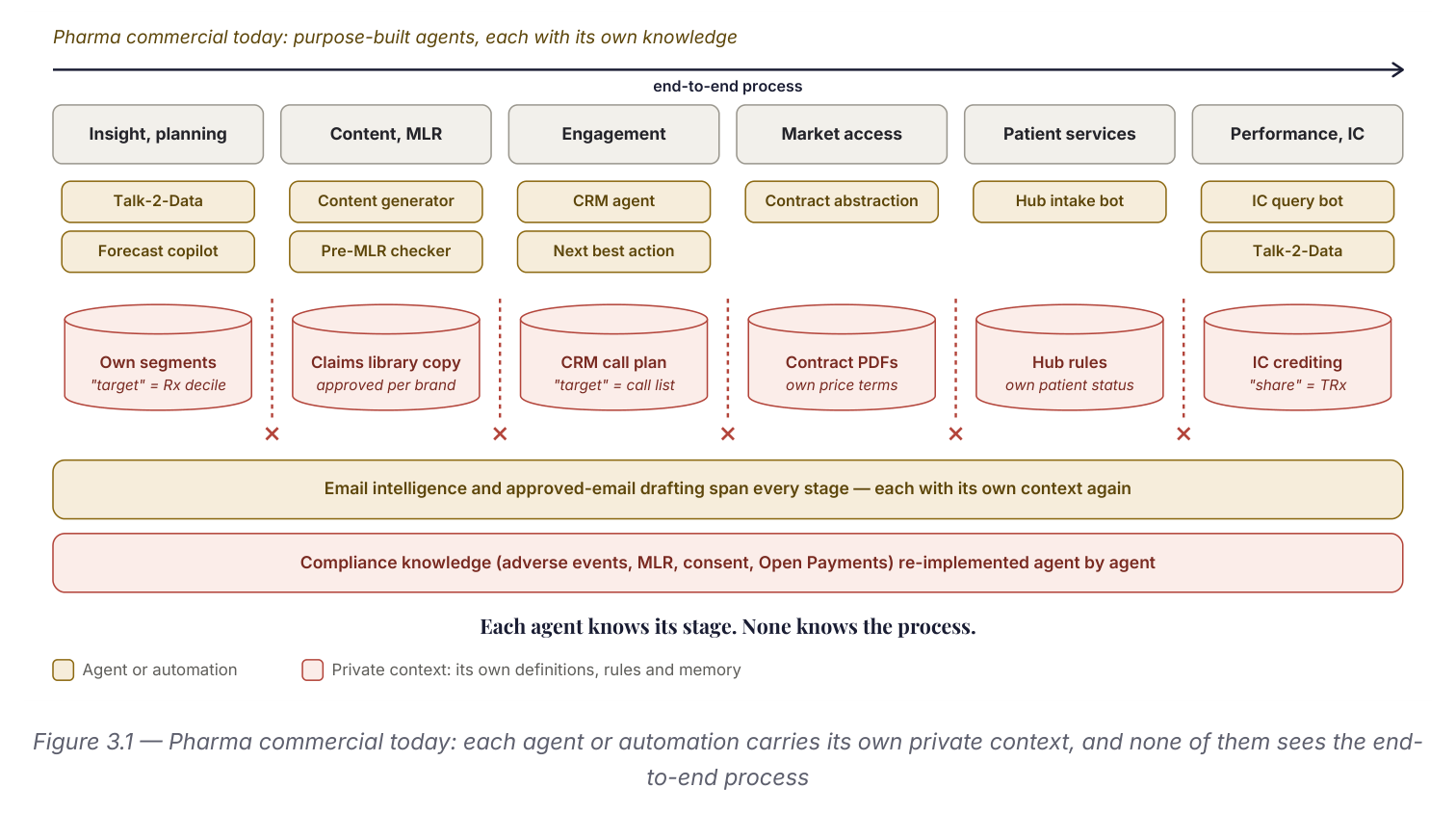
What pharma commercial and finance teams are building today, why it works, and where it lands if it continues
Commercial is where pharma has moved fastest with AI — and where knowledge is most scattered across brands, channels, vendors and teams.
Before arguing for a different architecture, it is worth being precise about what exists today. This chapter walks the commercial process from end to end, sets out what organizations are typically doing to improve it with agents and automation, and shows where the knowledge breaks. Chapter 4 does the same for finance.
Pharma commercial runs as a loop: understand the market, plan the brand, create approved content, engage healthcare professionals and accounts, secure access, support patients, measure performance — and plan again. Compliance runs through every stage.
| Stage | What happens | Knowledge it depends on |
|---|---|---|
| Insight and brand planning | Market sizing, forecasting, segmentation and targeting; brand strategy and resource allocation | Market and segment definitions; what "target" and "share" mean; forecast assumptions |
| Content and MLR | Promotional and medical content created, then reviewed by medical, legal and regulatory before use | Approved claims by indication and audience; brand guidelines; fair-balance rules |
| Omnichannel engagement | Field calls, remote engagement, approved email, digital channels and events, guided by call plans and next-best-action | Call plans and targets; consent; sample rules; what the rep may and may not say |
| Market access and contracting | Payer and formulary strategy; contracts with payers, GPOs and integrated delivery networks | Contract terms; formulary status; government-price implications |
| Patient services | Hub enrollment, benefits verification, specialty pharmacy coordination, adherence support | Patient status definitions; program eligibility; privacy rules |
| Performance and incentive compensation | Sales crediting, brand performance reporting, field incentive compensation | Crediting rules; goal-setting logic; metric definitions |
| Compliance (across all) | Adverse-event capture from any channel; medical–commercial separation; transparency reporting; sample accountability; consent | What must be reported, by whom and when; what may be said to whom |
Most commercial organizations now run a portfolio of AI initiatives. Each was chosen for a real problem, and most deliver visible value. They are typically shallow agents with a harness: a prompt that encodes the rules, a handful of tools or connectors, a private retrieval index, some guardrails and a small test set — built for one purpose, by one team, often on one vendor's platform. This is a sensible portfolio, and we would not advise stopping it. The question is what it adds up to.

Each initiative works within its stage. The breaks appear when a question, a rule or a risk crosses stages — which, in commercial, most of the important ones do.
| What happens | Why | Consequence |
|---|---|---|
| Two agents disagree on who the "target" HCPs are | Planning defines targets by prescription decile; the CRM agent uses the approved call plan; next best action uses its own segments | Reps receive conflicting suggestions; trust in all of them falls |
| Talk-2-Data and the brand team report different market share | One counts total prescriptions, another new-to-brand prescriptions, another patient share — each correct, none labeled | Executive time spent reconciling numbers, as in the guidebook's seven revenues |
| Generated content fails MLR review | The content agent's claims index is a copy, not the current approved library, and it doesn't know the audience's specialty from CRM | Rework and longer review cycles — the saving disappears downstream |
| A safety signal is routed as a service request | Email intelligence classifies by its own rules; pharmacovigilance knowledge of what counts as an adverse event is not in its context | Compliance exposure: adverse events must be captured from every channel within regulatory timelines |
| Next best action suggests promoting where access was just lost | Formulary changes live in market-access knowledge; supply allocation lives in plan-to-produce; neither is in the model's features | Wasted calls and, worse, messages the business would not stand behind |
Every break above sits at a boundary between stages. Within a stage, the agent is accurate. Across stages, it is either contradicting another agent, missing knowledge another agent has, or re-implementing a rule — often compliance — that should have been shared.
Finance has automated for longer than commercial, so its silos are older — and its numbers carry legal weight.
| Stage | What happens | Knowledge it depends on |
|---|---|---|
| Plan and forecast | Long-range plan, budget, latest estimates; brand and portfolio forecasts reconciled with commercial | Plan versions, assumptions, the basis on which "net sales" was planned |
| Gross-to-net and accruals | Rebates, chargebacks, government programs and returns estimated, accrued and trued up | Contract terms, program rules, accrual models, estimation policy |
| Procure-to-pay | Requisitions, purchase orders, receipts, invoices, payments | Approval limits, tolerances, payment terms, supplier master |
| Record, close and reconcile | Postings, reconciliations, intercompany, consolidation, period close | Posting and tie-out rules, close calendar, SOX controls |
| Report and explain | Management and external reporting; variance and flux commentary | Metric definitions, driver trees, disclosure policy |
| Government pricing | Calculation and certification of government-defined prices | Legally defined price concepts and methodologies |
| Treasury and cash | Cash forecasting, collections, liquidity | Payment behavior by customer, terms, forecast models |

| What happens | Why | Consequence |
|---|---|---|
| The variance agent explains a miss as "price" | It sees the numbers; commercial knows a formulary loss shifted volume to a lower-priced channel | Commentary that is plausible, confident and wrong |
| Accruals lag a contract change | A contract amendment was abstracted by a commercial contracting tool; the accrual model's copy of terms was not updated | Under-accrual, then a true-up that surprises the controller |
| Plan and actual don't compare like with like | Plan was built on one net-sales basis; actuals follow the current gross-to-net estimate; Talk-2-Data uses a third | Variance meetings spent on definitions, not decisions |
| Matching rules nobody owns | Tolerances sit in tool configuration and spreadsheets; procurement negotiated different terms | Payments released or blocked for reasons no one can explain |
| AI-drafted commentary reaches a disclosure | No record of which parts were generated, reviewed or rewritten | A disclosure-control gap that is hard to see until an auditor asks |
The most expensive gaps are not inside either function but between them. A contracting decision in commercial changes gross-to-net in finance, may affect a government-price benchmark, and ends up in reported revenue. A brand forecast becomes a budget. A formulary loss becomes a variance. Each step is handled competently by people and, increasingly, by agents — but no knowledge connects the chain from the contract to the reported number. Part V shows that chain explicitly; here, the point is that today's agents sit on either side of it, unaware of each other.
An agent is only as connected as the knowledge it draws on. When every agent carries its own knowledge, the organization has automated its silos.
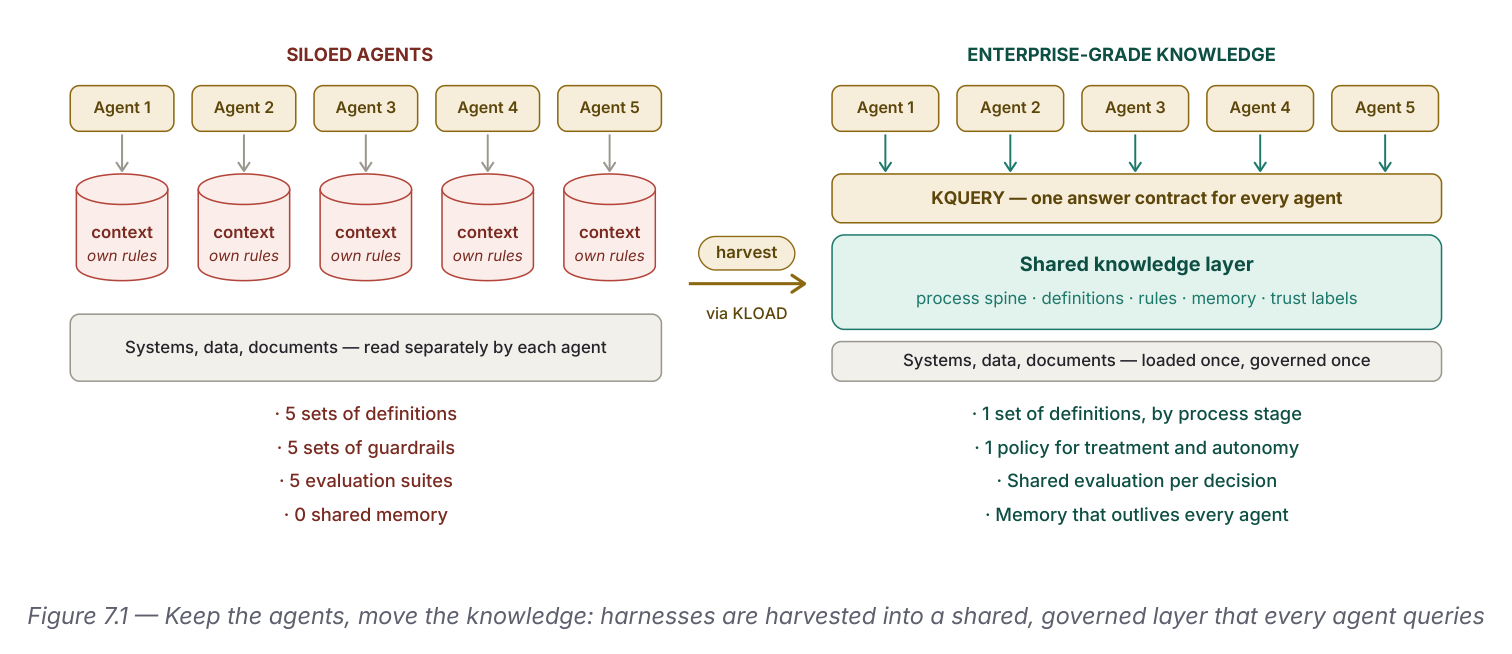
A Siloed Agent is a purpose-built agent whose knowledge — its definitions, rules, context and memory — is assembled inside its own harness for its own use case, rather than drawn from a shared, governed knowledge layer that follows the end-to-end process. A siloed agent estate is what an organization has when most of its agents are built this way.
A harness is everything around the model that makes an agent useful for one purpose. Each part of it contains knowledge — and in a Siloed Agent, all of that knowledge is private.
| Harness part | What it holds | What happens to that knowledge |
|---|---|---|
| Instructions (prompt) | Definitions, business rules, policies and tone, written in prose | Unversioned, unowned by the business, invisible to other agents |
| Retrieval index | Copies of documents, claims, contracts or policies | Drifts from the source; no signal of what is current |
| Tools and connectors | Which systems it reads, and how it interprets their fields | Each agent interprets the same field its own way |
| Guardrails | What it must never say or do — often compliance rules | Re-implemented, slightly differently, in every agent |
| Evaluation set | Examples of right and wrong answers | Tests one agent; says nothing about consistency across agents |
| Memory | Conversation history, sometimes user preferences | Lost to the rest of the organization |
The guidebook described the shadow semantic layer: business logic embedded in thousands of report files that nobody designed, nobody governed and nobody could inventory. The siloed agent estate creates its successor. Definitions and rules move out of report files and into prompts, private indexes and guardrails. We call this the shadow context layer.
| Reporting era | Agent era | |
|---|---|---|
| Where logic hides | Report files (.rpt, .rdl, .pbix) | Prompts, private indexes, guardrails |
| What it creates | Shadow semantic layer | Shadow context layer |
| Who builds it | Self-service authors | Use-case teams and platform vendors |
| Why it is hard to see | Polished dashboards discourage questions | Fluent answers discourage questions even more |
| Migration cost | Knowledge archaeology; report migrations underestimated 3–5× | The same — unless the knowledge is harvested now |
Self-service BI democratized semantic fragmentation. Siloed agents automate it.
Siloed Agents are not a mistake; they are the rational result of how AI work is funded and delivered. Each use case has a sponsor, a budget and a deadline. Vendors ship agent features inside the systems people already use. Keeping scope narrow contains risk and makes compliance review tractable. And proving value quickly is how AI programs earn the right to continue. All of that is sensible. The cost appears only in aggregate.
| Work item | Siloed Agent | On enterprise knowledge |
|---|---|---|
| Find and agree definitions | Rediscovered with each team, often re-argued | Resolved from the shared spine |
| Curate context | New index, new copies of documents | Reuse governed knowledge objects |
| Encode rules and policies | Written into a new prompt | Already executable and owned |
| Compliance review (MLR, PV, SOX) | Repeated for each agent | Shared compliance knowledge reviewed once; agent-specific review only |
| Evaluation | New test set, tests one agent | Golden questions per decision, shared across agents |
| Integration with other agents | Point-to-point, grows with every agent | Through one query layer |
| Maintenance when rules change | Edit every affected harness | Change once; propagated to every consumer |
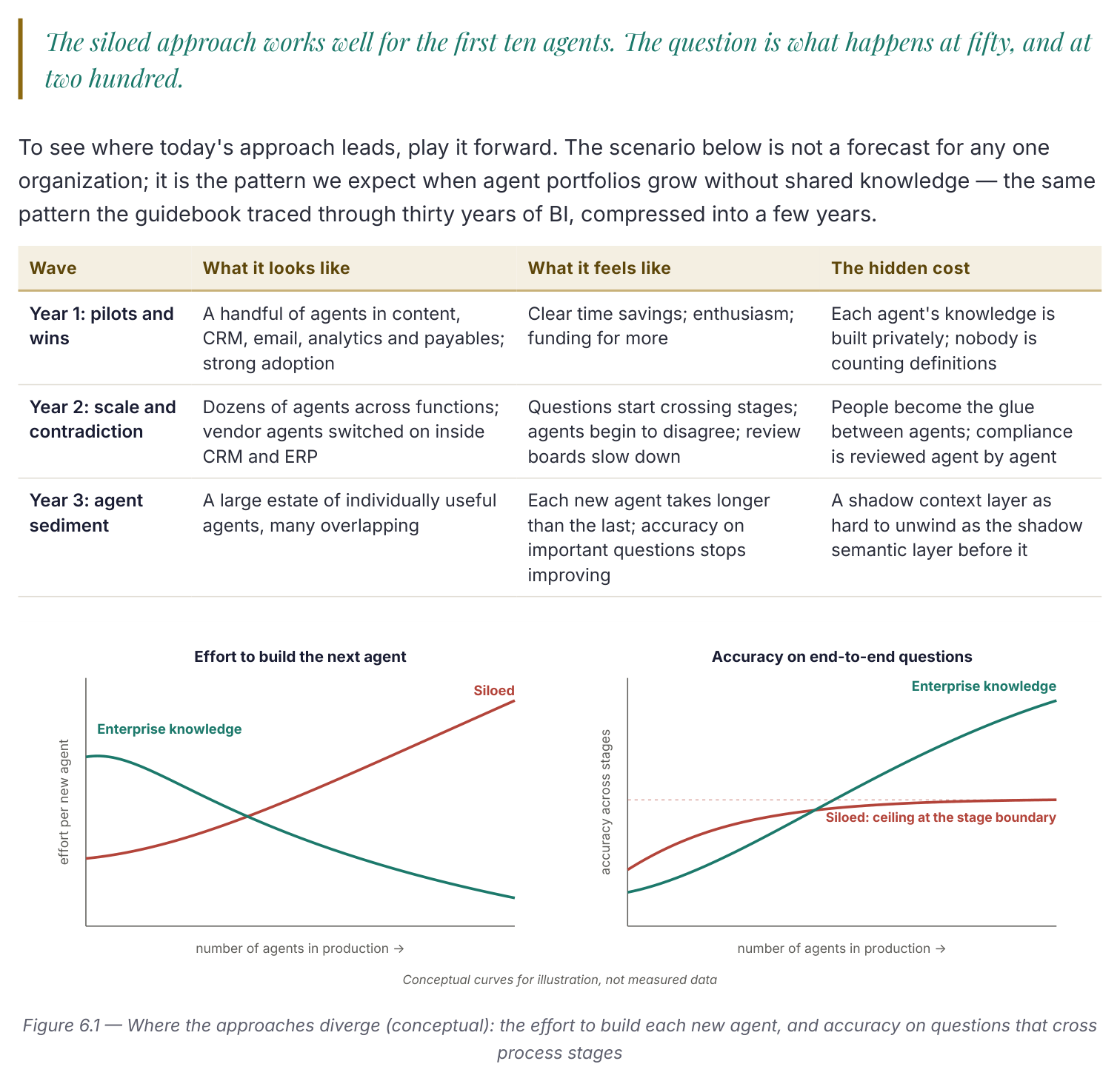
The siloed approach works well for the first ten agents. The question is what happens at fifty, and at two hundred.
| Wave | What it looks like | What it feels like | The hidden cost |
|---|---|---|---|
| Year 1: pilots and wins | A handful of agents in content, CRM, email, analytics and payables; strong adoption | Clear time savings; enthusiasm; funding for more | Each agent's knowledge is built privately; nobody is counting definitions |
| Year 2: scale and contradiction | Dozens of agents across functions; vendor agents switched on inside CRM and ERP | Questions start crossing stages; agents begin to disagree; review boards slow down | People become the glue between agents; compliance is reviewed agent by agent |
| Year 3: agent sediment | A large estate of individually useful agents, many overlapping | Each new agent takes longer than the last; accuracy on important questions stops improving | A shadow context layer as hard to unwind as the shadow semantic layer before it |

The siloed approach does not fail. It plateaus — against three ceilings that better prompts and better models cannot raise, because they are properties of the knowledge, not of the agent.
Accuracy. Within a stage, a well-built agent is accurate. Across stages, accuracy is capped by the most inconsistent definition it touches. If "net sales", "target" or "market share" mean different things in different harnesses, an end-to-end answer is only as good as the worst match — and no agent can tell, because none carries provenance or knows the alternatives exist.
Relevance. Relevance depends on context the agent does not have. A next-best-action suggestion is only relevant if it knows about the formulary loss, the supply constraint and the open safety signal. Siloed Agents are relevant to their stage and blind to the process.
Efficiency. Early savings are real, but they are eroded by rework downstream (content that fails review), by people reconciling agents, and by the rising cost of every new agent. Efficiency gains flatten exactly when the organization tries to scale.
More capable models make Siloed Agents more fluent, not more consistent. A stronger model reasoning over a private, partial context produces a more convincing partial answer. The guidebook's warning applies directly: the fluency is the hazard.
Played forward, the current approach lands in a familiar place: a large, expensive estate of individually useful tools that together reproduce the fragmentation they were meant to overcome. The guidebook called the BI estate sediment. A siloed agent estate is sediment that talks.
Keep the agents. Move the knowledge.
The answer to the Siloed Agent is not fewer agents. It is a different place for their knowledge: a shared layer that follows the end-to-end process, is governed once, and is used by every agent — enterprise, vendor-embedded and those not yet built.
| Property | What it requires |
|---|---|
| End to end | Knowledge organized along the process, with every handoff modeled — from contract to reported revenue, from brand plan to budget |
| Shared | One query path and one answer contract for every agent |
| Governed | Named owners with authority; governance proportional to risk |
| Trusted | Every claim labeled with its class, origin and assurance |
| Compliant by design | Pharmacovigilance, MLR, consent, transparency and SOX rules held once, as shared knowledge, and enforced for every agent |
| Auditable | Every answer reproducible; every action and decision remembered |
| Reusable | Decision-first, so each new agent draws on what already exists |

Today's agents prove value, build adoption and teach organizations how to work with AI. Kept as they are, they will plateau on accuracy, relevance and efficiency, and every new agent will cost more than the last. Moved onto end-to-end, enterprise-grade knowledge, the same agents become consistent, connected and cheaper to extend.
Six kinds of knowledge, one epistemic profile, and the process knowledge enterprises already hold without knowing it
A definition, a rule, a policy, an estimate, a rule of thumb and a hypothesis are different kinds of statement. An agent that treats them alike will eventually present a guess as a fact.

| Class | What it is | Trust stance | How an agent uses it |
|---|---|---|---|
| DEFINITIONAL | What a concept means | Authoritative within scope and version | Resolve it; never paraphrase |
| DETERMINISTIC | A rule, calculation or control: same input, same output | Authoritative within scope and version | Execute it; never paraphrase |
| NORMATIVE | What should happen: policies, plans, targets, contract terms | Authoritative as a commitment, not a prediction | Compare actuals against it |
| PROBABILISTIC | A quantified estimate from a model | Proportional to calibration | Invoke the model; report an interval |
| HEURISTIC | Codified expert judgment | Within scope, weighted by hit rate | Advise, showing where it applies and how often it has been right |
| GENERATED | Model-produced synthesis, explanation or hypothesis | Untrusted until verified | Present as a hypothesis only |
Definitional is not deterministic. A definition says what net revenue means. A deterministic rule says how a system computes it, or when it blocks an order. They are separate classes because the definition can be right while the rule implementing it is wrong — the gap between what was intended and what was implemented. Consider a common pattern: a sales policy requires regional approval above a 10% discount, the CRM approval process triggers at 15%, and the ERP pricing procedure allows manual discounts up to 20% with no block at all. Each is "the rule" to someone. Only separating meaning from mechanism makes the gap visible.
Probabilistic is not generated. Both are uncertain, but differently. A probabilistic model's uncertainty is characterized: it can be calibrated, backtested and stated as an interval. A generated explanation's uncertainty is not: the same prompt can produce a different answer tomorrow, and nothing measures how often it is right. An agent must say "estimated at $62M (±$6M)" for the first and "a possible explanation, not yet verified" for the second.
Normative knowledge is a commitment, not a forecast. A plan, a target, a contract price or a registered specification states what should be true. It is authoritative as a commitment and useless as a prediction. Variance-to-plan — the most common executive question — is a comparison between normative and factual knowledge, which is why plan data cannot be left out of the knowledge layer.
Fact references are not a class. Facts live in systems of record. The knowledge layer holds references to them — pointers with an as-of time and a data-quality signal — so an agent can cite a fact without restating it from memory.
"Type" is used loosely in most knowledge programs. We separate three independent ways of classifying a knowledge object, plus the concrete schema it conforms to:
| Axis | Question | Values |
|---|---|---|
| Epistemic class | How far to trust it, how to use it | The six classes above |
| Intelligence domain | What kind of organizational intelligence | The guidebook's eight types: structured operational, contextual, process, relational, temporal, tacit expert, regulatory, environmental |
| Process anchor | Where in the enterprise it applies | Value chain and stage: order-to-cash, plan-to-produce, record-to-report, source-to-pay, plan-to-perform… |
| Knowledge object type | Its concrete schema | E.g. metric_definition, control, contract_term, model, playbook_rule, hypothesis (Appendix C) |
The axes are orthogonal. A heuristic can be tacit expert knowledge or temporal knowledge; a deterministic rule can be regulatory or process knowledge. Keeping them separate is what lets an agent answer "which rules govern this stage of order-to-cash, and which of them are only rules of thumb?"
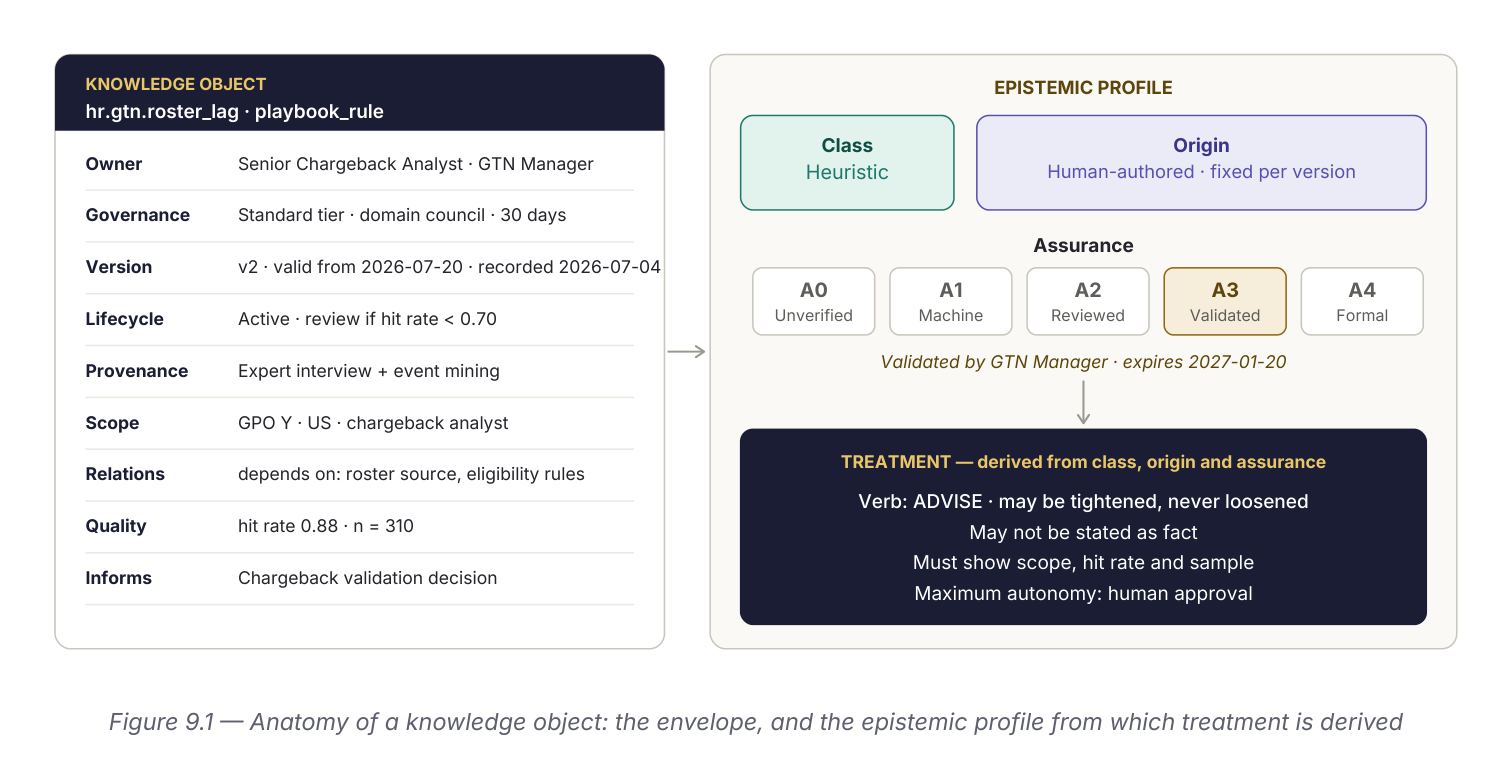
Before an agent uses any piece of knowledge, it must know four things: what kind of knowledge it is, who or what wrote it, who has vouched for it, and therefore how it may be used.
Every knowledge object (KO) carries the same envelope, whatever its class. The envelope makes the five defining properties operational:
| Field | Purpose |
|---|---|
| Identity and type | A stable ID and a type declared in KDEFINE |
| Epistemic profile | Class, origin, assurance and derived treatment |
| Domain and process anchor | Intelligence domain; value chain and stage |
| Owner | Business owner (authority), steward (maintenance), custodian (technical) |
| Governance | Tier, approver, resolution deadline |
| Version | Number, valid time, record time, rationale — bitemporal |
| Lifecycle | State and review triggers |
| Conformance | For deterministic KOs: intended (owner-approved) or implemented (as enforced by a system) |
| Provenance | Sources, extraction run and method, evidence |
| Scope | Org unit, system instance, market, segment, persona, period |
| Relations | Depends on, implements, conflicts with, deviates from, supersedes, informs |
| Quality | Class-specific: extraction scores, calibration, hit rate |
| Access | Policy inherited from the source systems |
| Informs | The decisions it serves — mandatory |

The profile has four parts. Three are recorded; the fourth is derived.
Class. One of the six classes (Chapter 8). Class changes only through promotion — for example, a verified hypothesis becoming contextual knowledge — which creates a new knowledge object.
| Origin | Meaning |
|---|---|
human_authored | Written by a named person: policy owner, expert, council |
system_extracted | Read from a system of record's configuration or metadata |
machine_derived | Produced by a statistical or mining process: a trained model, a mined process pattern |
ai_generated | Produced by a language model |
ai_drafted_human_edited | A language-model draft that a named person materially revised |
Origin is fixed for each version and never upgraded. AI-authored knowledge stays AI-authored after a human approves it; the approval is recorded as assurance. This is what allows an organization to answer, years later, whether a specification, a procedure or a disclosure was written by AI — a question regulators have already started to ask.
| Level | Meaning | Who |
|---|---|---|
| A0 UNVERIFIED | No check yet | — |
| A1 MACHINE | Checked deterministically against its source | Automated verification |
| A2 REVIEWED | A named person read it and found no problems | Steward or reviewer |
| A3 VALIDATED | The accountable owner formally approved it for use | Business owner or council |
| A4 FORMAL | Validated under a controlled process — GxP CSV, SOX change control | QA or compliance, with evidence |
Assurance belongs to a version — a new version starts again at A0, or A1 where automated verification applies. Assurance expires: each level has a review interval, and when it lapses the object drops a level and agents must say so.
| Class | Verb | How the agent phrases it | May it drive an action? |
|---|---|---|---|
| Definitional | RESOLVE | "X is defined as…" | Indirectly, through rules |
| Deterministic | EXECUTE | Computes; never paraphrases | Yes, at A3 or above |
| Normative | COMPARE | "Policy says… / the plan was…" | Yes, as justification, at A3+ |
| Probabilistic | ESTIMATE | "Estimated at… (interval, calibration date)" | Only from a validated model with a threshold |
| Heuristic | ADVISE | "Experienced practitioners find…, where…" | Never as the sole basis |
| Generated | HYPOTHESIZE | "A possible explanation, not yet verified…" | Never |
| Fact reference | CITE | "SAP shows… as of…" | As an input |
Origin and assurance can only tighten that default. Unverified knowledge must be labeled as such and cannot drive an action. Lapsed assurance caps autonomy at human approval. AI-authored knowledge is excluded from any GxP critical path, whatever its assurance.
How labels appear to a decision-maker:
Origin is permanent. Approval never turns AI-authored knowledge into human-authored knowledge; it raises assurance instead. Assurance expires. Knowledge validated long ago is treated as unverified until someone looks at it again — the only real defense against institutional amnesia returning. Treatment is derived, not authored. No one can type "treat as fact" into a knowledge object. This is the one place the model removes human discretion, because the failure mode — a confident agent built on loosely labeled knowledge — is the one this whole architecture exists to prevent.

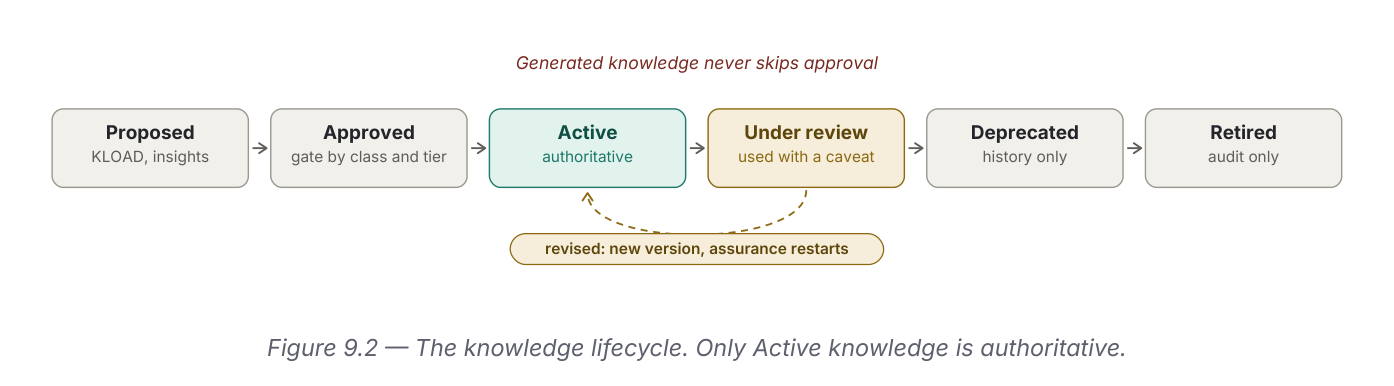
Knowledge objects move through six states: Proposed → Approved → Active → Under review → Deprecated → Retired. Only Active objects are authoritative; Under review objects can be used with a caveat; Deprecated objects answer historical questions only; Retired objects are kept for audit and invisible to agents. Generated knowledge never skips approval — the gate that stops error laundering.
Governance is proportional to risk, in four tiers: low (by default, heuristics and generated knowledge, reviewed by a steward), standard (definitions, policies and models, approved by a domain council), regulated (SOX-relevant controls and government-pricing rules, under formal change control with dual approval), and GxP-validated (quality, release and serialization knowledge, where validation status applies to the agents and prompts that consume it as well as to the knowledge itself).
Most of an enterprise's process knowledge is not in its process documents. It is in the configuration of the systems people use every day — enforced, unexplained, and invisible to agents.
A process begins as human action: someone approves a discount, releases a batch, books an accrual. Over time, parts of that action are codified in systems; the rest stays in spreadsheets, emails and habit. Systems such as SAP, Salesforce or Veeva, LIMS and QMS codify process in five places, and each holds a different kind of knowledge:
| Where | CRM (Salesforce, Veeva) | ERP (SAP) | Knowledge class |
|---|---|---|---|
| State model | Stages, statuses, record types | Document categories, statuses, document flow | Deterministic |
| Configuration | Validation rules, approval processes, pricing rules | Order types, copy control, pricing procedures, release strategies, tolerances | Deterministic — readable only from configuration |
| Code | Flows, triggers | Enhancements, custom programs | Deterministic — the most opaque |
| Integration | Connector mappings | Interfaces, mapping tables | Where meaning shifts between systems |
| Off-system | Spreadsheet approvals, email sign-offs | Manual journals, offline price lists | Heuristic or tacit |
The implication is direct: process knowledge built from SOPs describes the official process; process knowledge extracted from configuration describes the process the system actually enforces. The knowledge layer needs both — and the gap between them is often the most valuable finding of all.

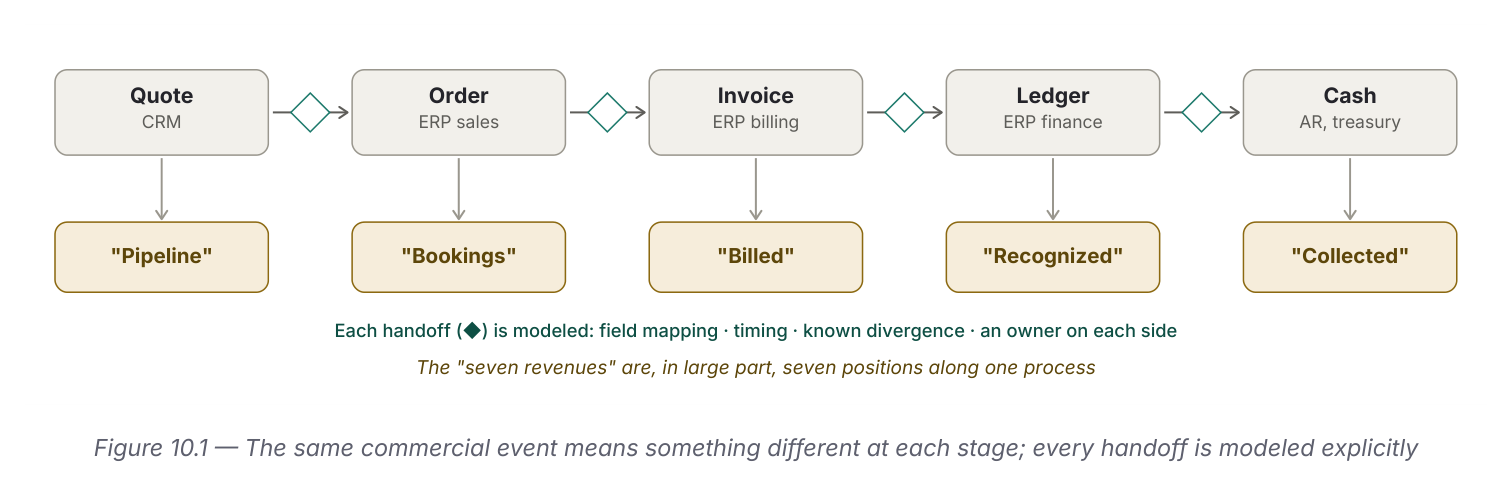
Every value chain crosses systems, and each crossing changes what a number means. In a generic order-to-cash chain, the same commercial event is pipeline at the quote, bookings at the order, billed at the invoice, recognized in the ledger and collected as cash. Each is a legitimate "revenue", and each lives in a different system. The guidebook's seven definitions of revenue are, in large part, seven positions along a process. The knowledge layer therefore models each handoff explicitly — field mapping, timing, known divergences and an owner on each side — and records the process stage on every definitional concept.
Every custom order type, tolerance setting and release strategy encodes a decision someone made. Almost none carry the rationale. When the knowledge layer extracts configuration, it should flag undocumented customizations as memory gaps, so an agent can say "this purchase order needs two approvals under release strategy X, but no one has recorded why" — rather than presenting an unexplained rule as settled fact.
Golden records in MDM are data and stay in the data platform. The rules that create them — match, merge, survivorship and hierarchy rules — are knowledge: they encode business decisions about which source wins for which attribute. Match, merge and survivorship rules are extracted as deterministic knowledge objects, and entity and hierarchy definitions as definitional ones, owned by the relevant data domain owner; and golden-record identifiers become the identity backbone for joining knowledge across systems. In pharma, these rules decide many chargeback disputes (Chapter 16).
An agent that understands process knows which stage a number belongs to, which rule produced it, whether that rule matches policy, and who owns each side of every handoff. An agent that does not will compare bookings with billed revenue and call the difference a variance.
A capability stack, six components and nine steps — from defining what valid knowledge is to proving that decisions improved
The stack begins and ends with the same people: humans acting, whose actions are codified in systems, and humans deciding, whose decisions become the next actions.

| Layer | Contents | Role |
|---|---|---|
| Humans: decision-makers | Executives, analysts, operators | Ask, review, decide, approve |
| Decision points | The decision catalog | Defines what each request needs |
| Consuming agents and applications | Enterprise agents, vendor-embedded agents, apps and BI | Present labeled insights; propose actions |
| Agent runtime | Context assembly, workflow, models, guardrails, action gateway | Builds context per request; acts through systems |
| Knowledge | KSTORE, with KDEFINE, KLOAD, KFLOW, KQUERY and KMONITOR | The governed, durable layer |
| Data platform | Integration, MDM, lakehouse | Moves, reconciles and stores data |
| Systems | Record (ERP, CRM, LIMS, MES, QMS), plan, engagement, external | Where process is codified and data originates |
| Humans: actors | The same people, acting | Enter, approve, write, know |
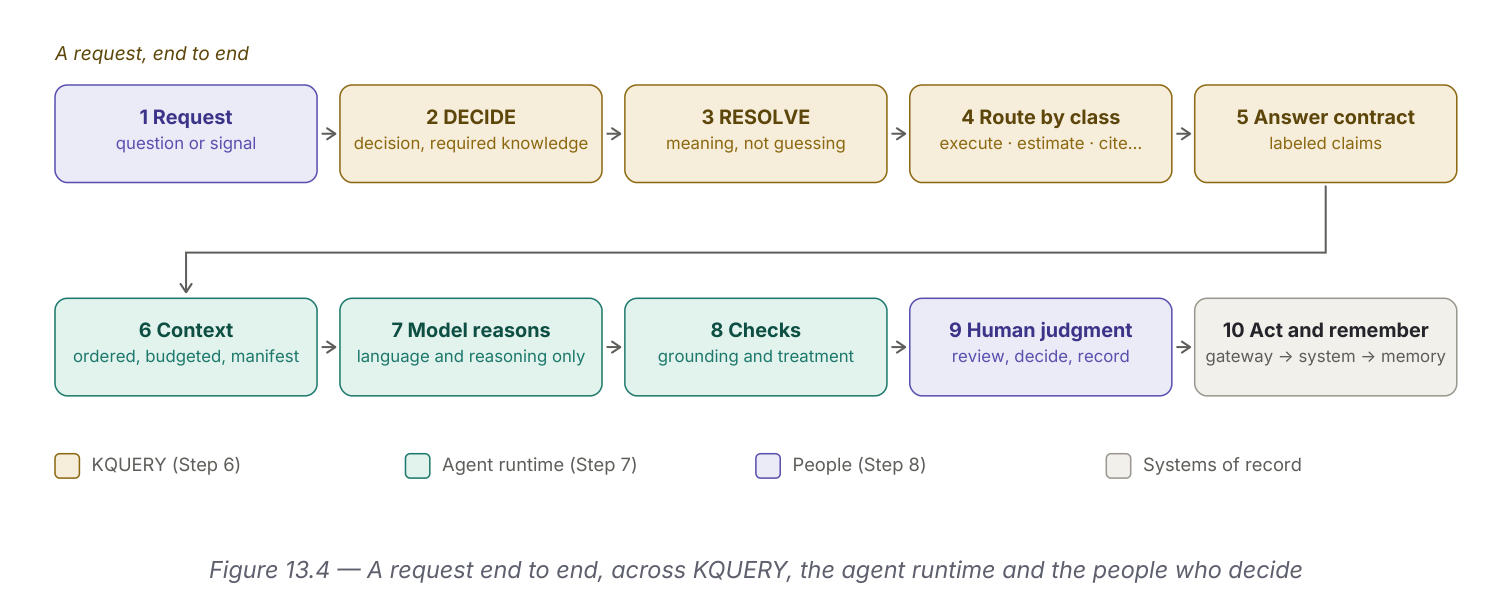
Context is runtime. Context is assembled for each request — the decision, the relevant knowledge, live facts, scope, entitlements, the as-of time and caveats — and is never stored as a layer. What persists is a context manifest attached to every answer, so any answer can be reproduced and audited.
Models supply language and reasoning, never enterprise facts. Definitions, rules, policies, estimates and facts reach the model only through context. Anything the model says about the enterprise must be grounded in that context, or it is removed or labeled as generated.
Agents act through systems, never around them. Every action passes the action gateway into a system of record, so that system's authorizations, electronic signatures and audit trail apply. Agents never write directly to data or to the knowledge store: their outputs go to the insight store and become knowledge only through validation.
Vendor-embedded agents are held to the same standard. Agents inside ERP and CRM screens will reach users first. They consume the enterprise knowledge layer, or they declare the limits of what they can answer.
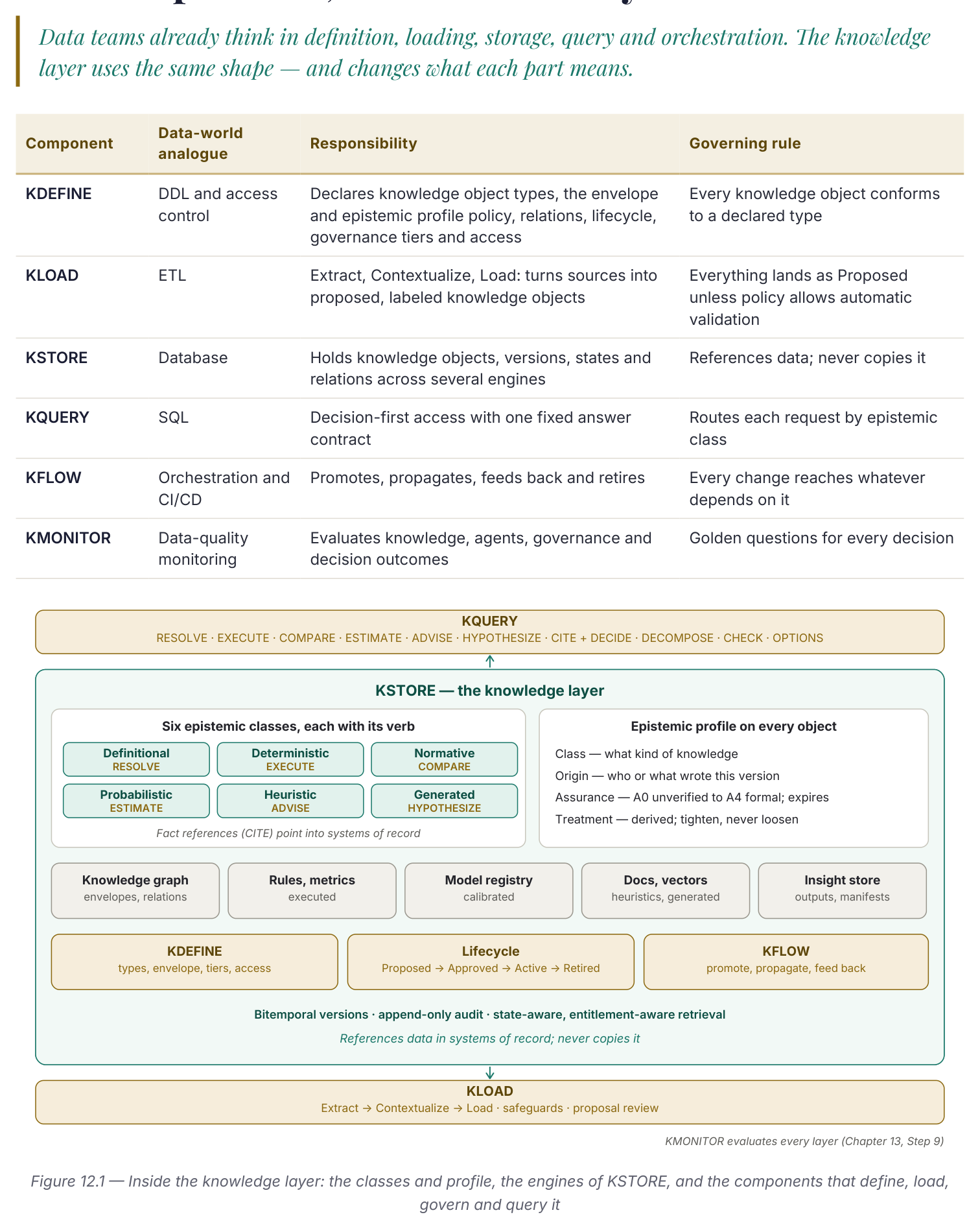
Data teams already think in definition, loading, storage, query and orchestration. The knowledge layer uses the same shape — and changes what each part means.
| Component | Data-world analogue | Responsibility | Governing rule |
|---|---|---|---|
| KDEFINE | DDL and access control | Declares knowledge object types, the envelope and epistemic profile policy, relations, lifecycle, governance tiers and access | Every knowledge object conforms to a declared type |
| KLOAD | ETL | Extract, Contextualize, Load: turns sources into proposed, labeled knowledge objects | Everything lands as Proposed unless policy allows automatic validation |
| KSTORE | Database | Holds knowledge objects, versions, states and relations across several engines | References data; never copies it |
| KQUERY | SQL | Decision-first access with one fixed answer contract | Routes each request by epistemic class |
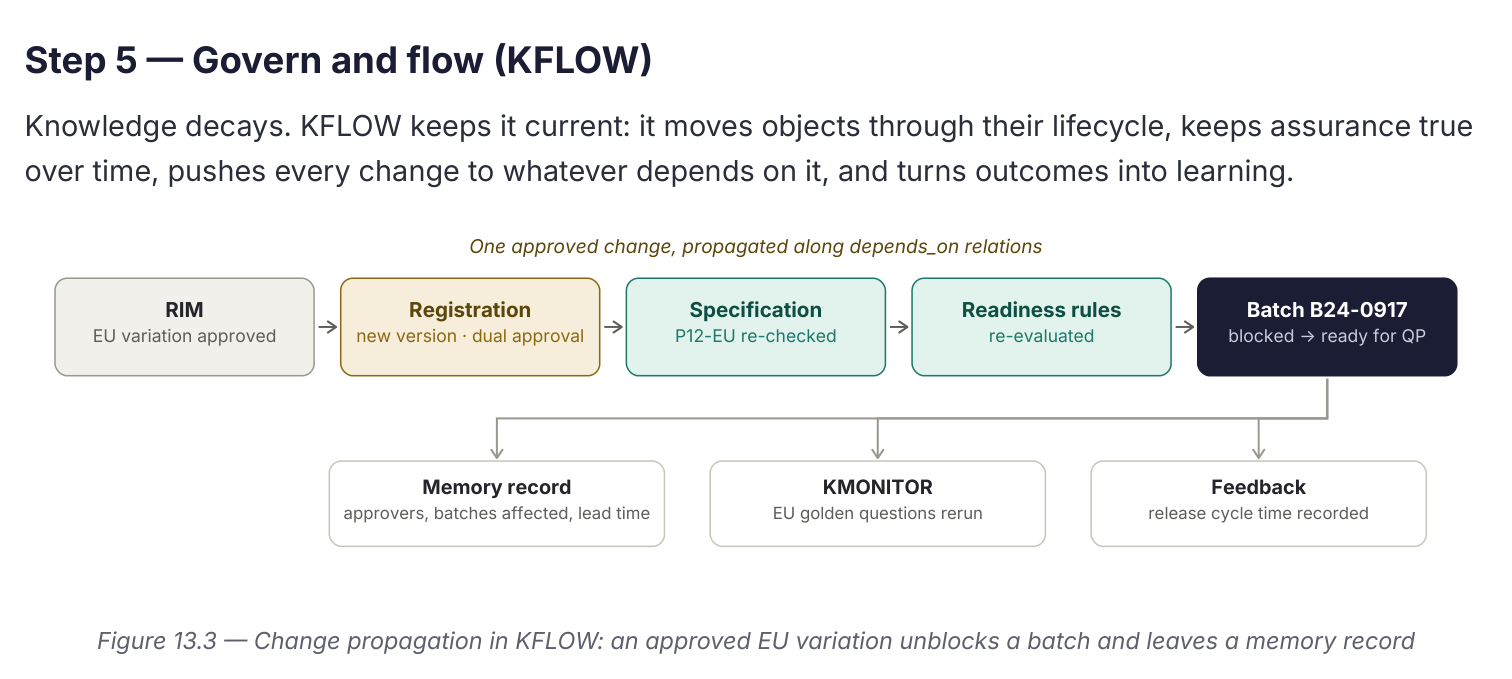
| KFLOW | Orchestration and CI/CD | Promotes, propagates, feeds back and retires | Every change reaches whatever depends on it |
| KMONITOR | Data-quality monitoring | Evaluates knowledge, agents, governance and decision outcomes | Golden questions for every decision |

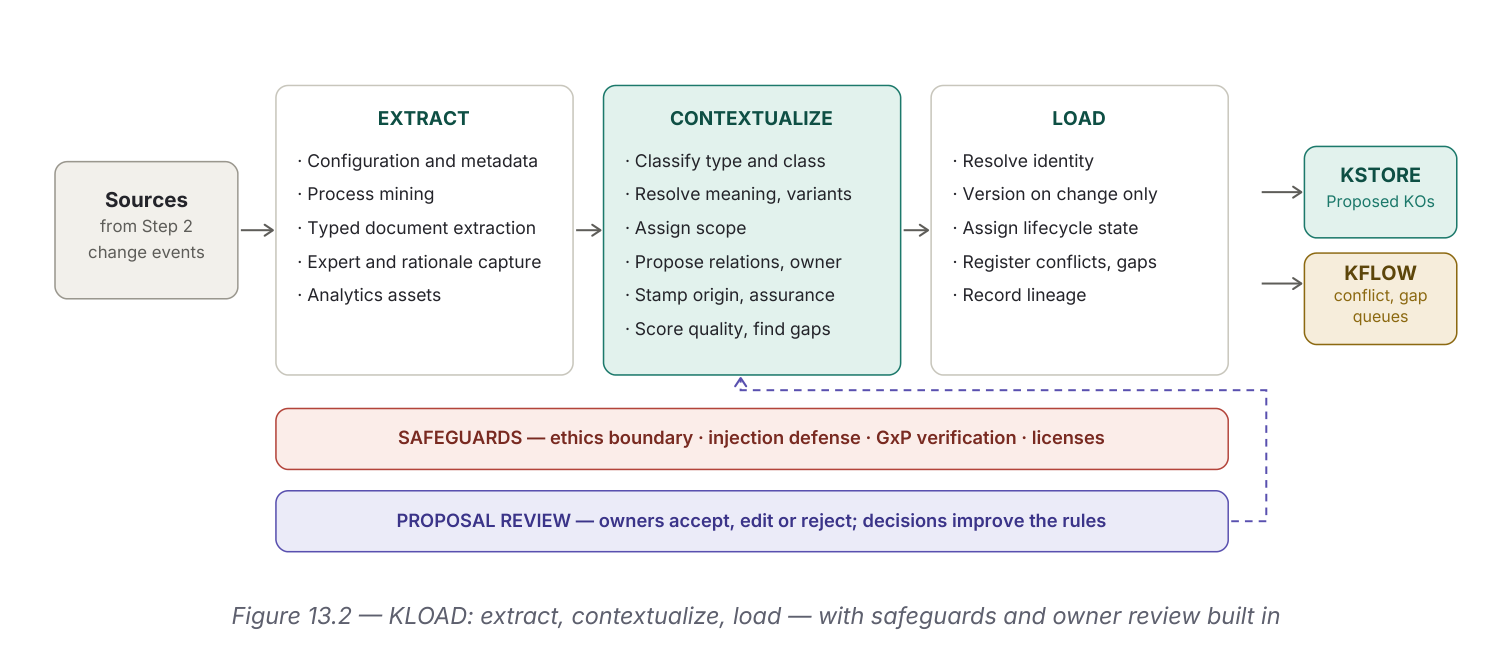
The middle letter of KLOAD carries the most weight. A data pipeline transforms — it changes the shape of data. KLOAD contextualizes — it adds meaning: type, class, scope, relations, ownership and origin. That is the step data engineering never had.
| Verb | Applies to | What it does |
|---|---|---|
| RESOLVE | Definitional | Returns the canonical meaning and scoped variants; disambiguates rather than guesses |
| EXECUTE | Deterministic | Runs a rule or calculation, pinned to a version |
| COMPARE | Normative | Compares actuals with a policy, plan, target or contract term |
| ESTIMATE | Probabilistic | Invokes a model and returns an interval with its calibration |
| ADVISE | Heuristic | Returns applicable rules of thumb with scope and hit rate |
| HYPOTHESIZE | Generated | Produces or retrieves explanations, labeled as unverified until validated |
| CITE | Fact references | Resolves a fact live from its system of record, with as-of time |
| DECIDE / DECOMPOSE / CHECK / OPTIONS | Structural | Loads a decision; evaluates a driver tree; tests controls against policy; lists eligible actions |
KDEFINE is a profile over existing standards. Concepts and variants compile to SKOS; type schemas and constraints to OWL and SHACL; metric definitions to Apache Ossie (the incubating successor to the Open Semantic Interchange specification) for exchange with vendor semantic layers; process models to BPMN; decision logic to DMN; provenance to PROV-O; and flow lineage to OpenLineage. What no standard yet covers well — bitemporal lifecycle, epistemic class, origin and assurance — is what KDEFINE defines itself.
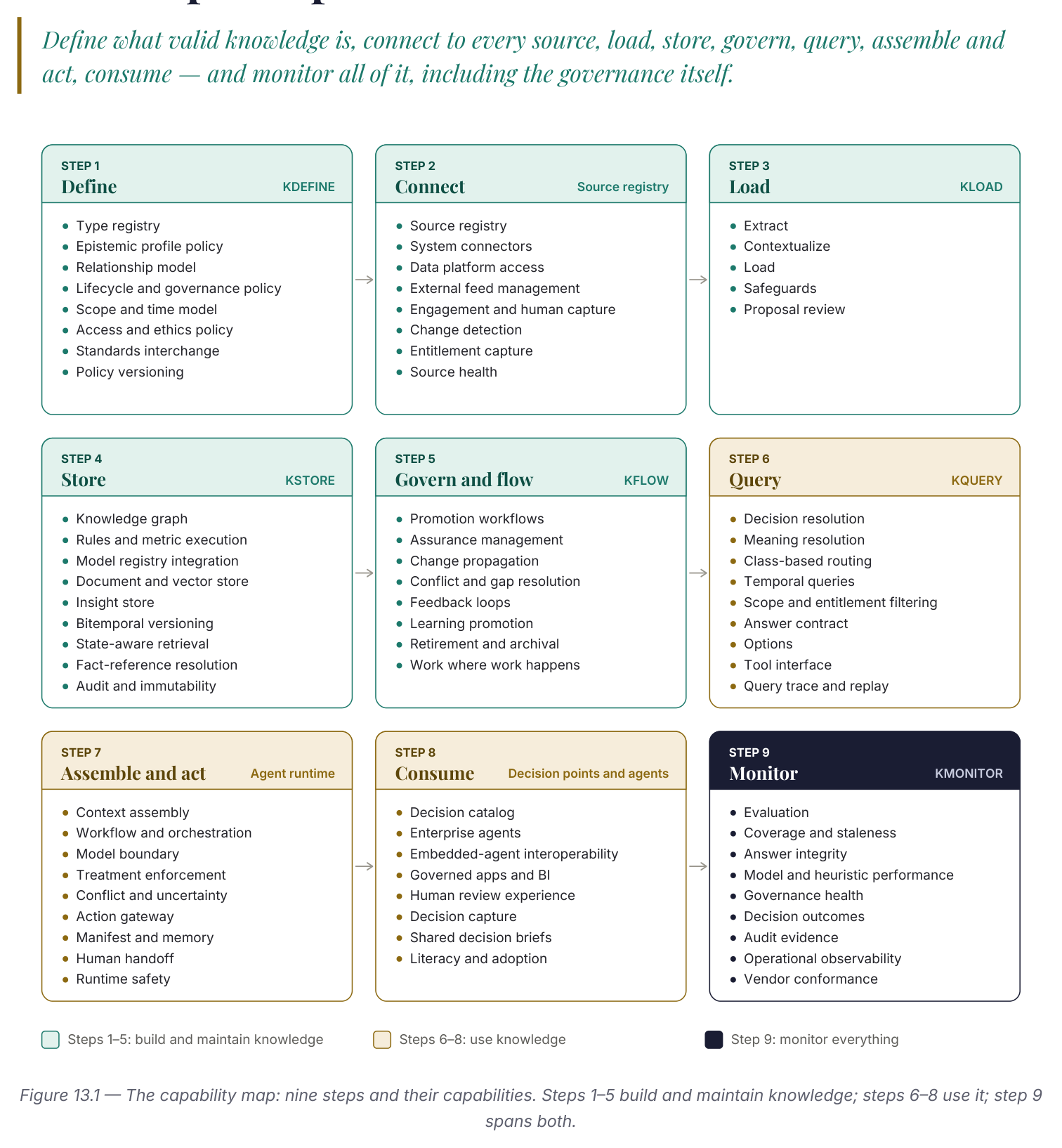
Define what valid knowledge is, connect to every source, load, store, govern, query, assemble and act, consume — and monitor all of it, including the governance itself.

Before anything is loaded, the architecture must state what counts as valid knowledge, how agents must treat each kind, and who may change what. KDEFINE is the architecture's constitution: every later step enforces rules set here. Its capabilities cover the type registry, epistemic profile policy, the relationship model, lifecycle and governance policy, scope and time, access and ethics policy, standards interchange, and policy versioning.
Treatment is policy, not content. Loosening one treatment rule changes the behavior of every agent at once, so changes to KDEFINE carry the highest approval in the architecture.
Knowledge is only as trustworthy as what it rests on. This step turns "we have SAP, Veeva, LIMS and some feeds" into a governed inventory of sources, each with a steward, a trust tier and a defined behavior when it goes stale. Each source carries a trust tier that caps the assurance knowledge derived from it alone can reach: validated systems of record can support A4; governed internal sources A4 outside GxP; authoritative external sources A3; unstructured internal sources — email, chat, spreadsheets — A2.
Connect for knowledge, not for replication. Connectors read configuration, metadata and events, and resolve facts by reference at query time.

KLOAD turns connected sources into proposed knowledge objects that conform to KDEFINE. It is where most of the architecture's AI is used, and therefore where most of its safeguards sit: an ethics boundary and redaction, injection defense (extracted content is data, never instruction), GxP controls, and license compliance.
AI proposes; owners decide. Conflicts and gaps are outputs, not errors — the first loads produce the governance agenda and the institutional-memory backlog.
One logical store over several engines, because different classes of knowledge are used differently: rules are executed, models invoked, heuristics retrieved and facts referenced. It carries a knowledge graph, rules and metric execution, model registry integration, a document and vector store, a separate insight store for agent outputs, bitemporal versioning, state-aware retrieval, fact-reference resolution, and an append-only audit trail.
Small and precise beats big and vague. KSTORE is measured by the decisions it covers, not the content it holds.

Knowledge decays. KFLOW keeps it current: promotion workflows, assurance management (expiry and downgrade), change propagation along dependencies, conflict and gap resolution, feedback loops that update heuristic hit rates and model calibration, learning promotion, and retirement.
Propagation is automatic; decisions are human. No change is silent.
KQUERY is the only way agents and applications reach knowledge. It asks "which decision is this for?" before "what data do I need?", routes each request by class, and returns everything under one answer contract: value, class, origin, assurance, versions, provenance, scope, as-of time, confidence, treatment and caveats.
Route, don't retrieve. Rules are executed and models invoked; only heuristics and generated knowledge are retrieved by similarity.

The runtime turns labeled claims into a working context, runs the agent's reasoning, checks its output against each claim's treatment, and executes actions through the systems of record: context assembly, workflow and orchestration, the model boundary, treatment enforcement, conflict and uncertainty handling, the action gateway, manifest and memory, human handoff, and runtime safety.
The model reasons; KSTORE knows. "I can't answer that reliably, because the roster feed is nine days stale" is a successful response.
Everything before this step exists to make decisions better. Intelligence comes to the decision, rather than the decision-maker navigating to data: the decision catalog, enterprise agents, embedded-agent interoperability with vendor semantic layers, governed apps and BI, a shared human review experience, decision capture, shared decision briefs, and literacy and adoption.
One governed path for every consumer — enterprise agents, vendor agents and dashboards alike.
An architecture that tells others how far to trust their knowledge must show how far it can itself be trusted: evaluation against golden questions, coverage and staleness, answer integrity, model and heuristic performance, governance health (the early warning of governance theatre), decision outcomes, audit evidence, operational observability, and vendor conformance.
Measure decisions, not usage. Active users say little; decision latency and outcomes say whether the architecture is worth its cost.
The knowledge layer is not a better data lake. It stores a different thing, for a different consumer, under different rules.
| Data warehouse | Data lake / lakehouse | Vector store (RAG) | Knowledge layer (KSTORE) | |
|---|---|---|---|---|
| Stores | Structured records of events | Raw and refined data of any shape | Text chunks and embeddings | Statements about meaning, rules, expectations, estimates and judgment |
| Answers | What happened? | What data do we have? | Which passages look similar? | What does it mean, what applies, what should happen, what is likely — and how far can I trust it? |
| Admission | Passes ETL | Anything can land | Anything can be embedded | Nothing is authoritative until validated; everything is labeled |
| Trust signal | Quality score at best | Usually none | Similarity score | Class, origin, expiring assurance, provenance |
| Versioning | Slowly changing dimensions | Storage snapshots | None | Bitemporal versions of meaning, with rationale |
| An AI gets | Numbers without meaning | Files without context | Plausible text without provenance | Labeled claims with a treatment it must follow |
Five differences matter most. Records versus statements: data stores hold what happened; the knowledge layer holds what the organization knows about it, and references the records rather than replacing them. Admission versus accumulation: a lake's strength — letting anything land — is exactly what produced the data swamp; built with lake rules, a knowledge layer becomes a knowledge swamp. Storage time versus business time: lakehouse time travel records when a file changed; the knowledge layer records when a meaning or rule applied to the business and when the organization learned it. Labels on the way out: a warehouse returns 226.0; the knowledge layer returns 226.0 and what kind of number it is. Description versus governance: a catalog says a revenue table exists; the knowledge layer says which revenue definition applies, who owns it, how it relates to the others, and how an agent must treat it.
The guidebook argued that no vendor architecture includes the layers above Gold. That needs revising. SAP now pairs Business Data Cloud with a knowledge graph intended to give its Joule agents semantic grounding. Across platforms, the Open Semantic Interchange initiative — supported by Snowflake, Salesforce, dbt Labs and a growing group of other vendors — has produced a vendor-neutral, open specification for semantic layers and ontologies, accepted into the Apache Incubator in June 2026 as Apache Ossie. Microsoft joined the effort in late September 2026.
They supply containers and interchange for meaning, and they cover one epistemic class well: definitional knowledge — metrics, dimensions and, increasingly, ontologies. They do not supply the organization's own content, owners with authority, the normative, probabilistic, heuristic and generated classes, decisions, bitemporal lifecycle, or reconciliation across vendors. Our position is therefore cooperative, not competitive: the knowledge layer publishes governed definitions into vendor semantic layers wherever they are supported, and requires embedded agents to consume enterprise knowledge or declare their limits. Vendors supply the container; the organization supplies — and stands behind — what goes in it.
Three US pharma value chains and three wedges — where the knowledge model meets gross-to-net, GMP release and the month-end close
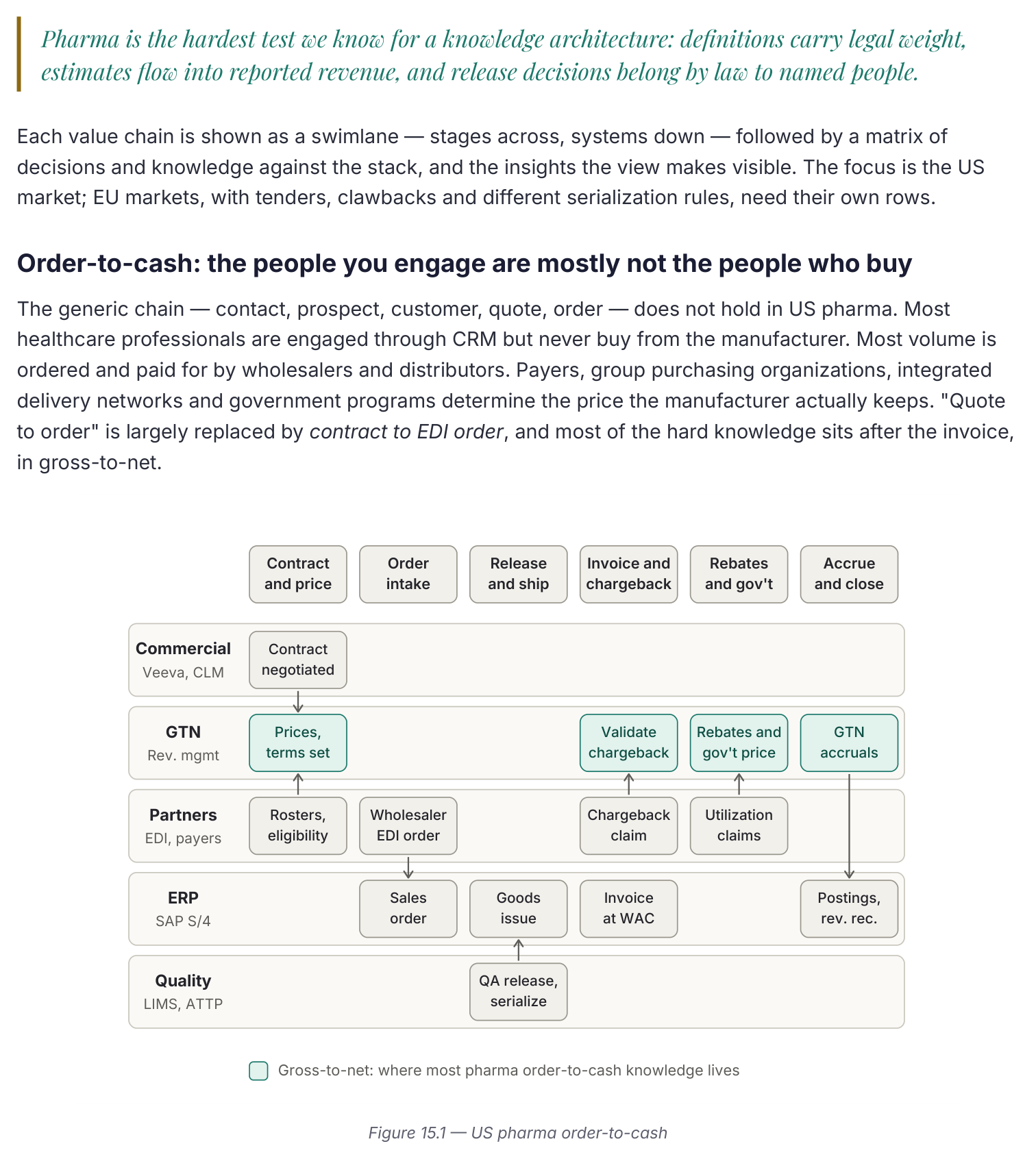
Pharma is the hardest test we know for a knowledge architecture: definitions carry legal weight, estimates flow into reported revenue, and release decisions belong by law to named people.
The generic chain — contact, prospect, customer, quote, order — does not hold in US pharma. Most healthcare professionals are engaged through CRM but never buy from the manufacturer. Most volume is ordered and paid for by wholesalers and distributors. "Quote to order" is largely replaced by contract to EDI order, and most of the hard knowledge sits after the invoice, in gross-to-net.

| Stage | Key decision | Where meaning shifts |
|---|---|---|
| Contract and price | Approve a contract price | A commercial discount can change a government price benchmark |
| Order intake | Allocate in shortage; release holds | EDI ship-to and sold-to versus MDM identity |
| Release and ship | Release a batch; ship a cold-chain lane | "Available" in ERP is not "released" in QMS |
| Invoice and chargeback | Accept or dispute a chargeback | List price, contract price and net price all differ |
| Rebates and government | Pay or dispute rebates; certify government prices | Claims arrive months after the sale |
| Accrue and close | Set gross-to-net and returns reserves | Reported net revenue includes an estimate |
Net revenue is partly probabilistic knowledge. Gross-to-net accruals are model estimates of rebates, chargebacks and returns not yet claimed, and under ASC 606 they flow into reported net revenue as variable consideration. Contract decisions reach beyond the contract: a very deep commercial discount can lower a government price benchmark and raise rebate liability across a whole program. MDM decides chargebacks: many disputes are eligibility questions — was this hospital on the roster on the date of sale? — answered by survivorship and roster rules that must be held bitemporally.
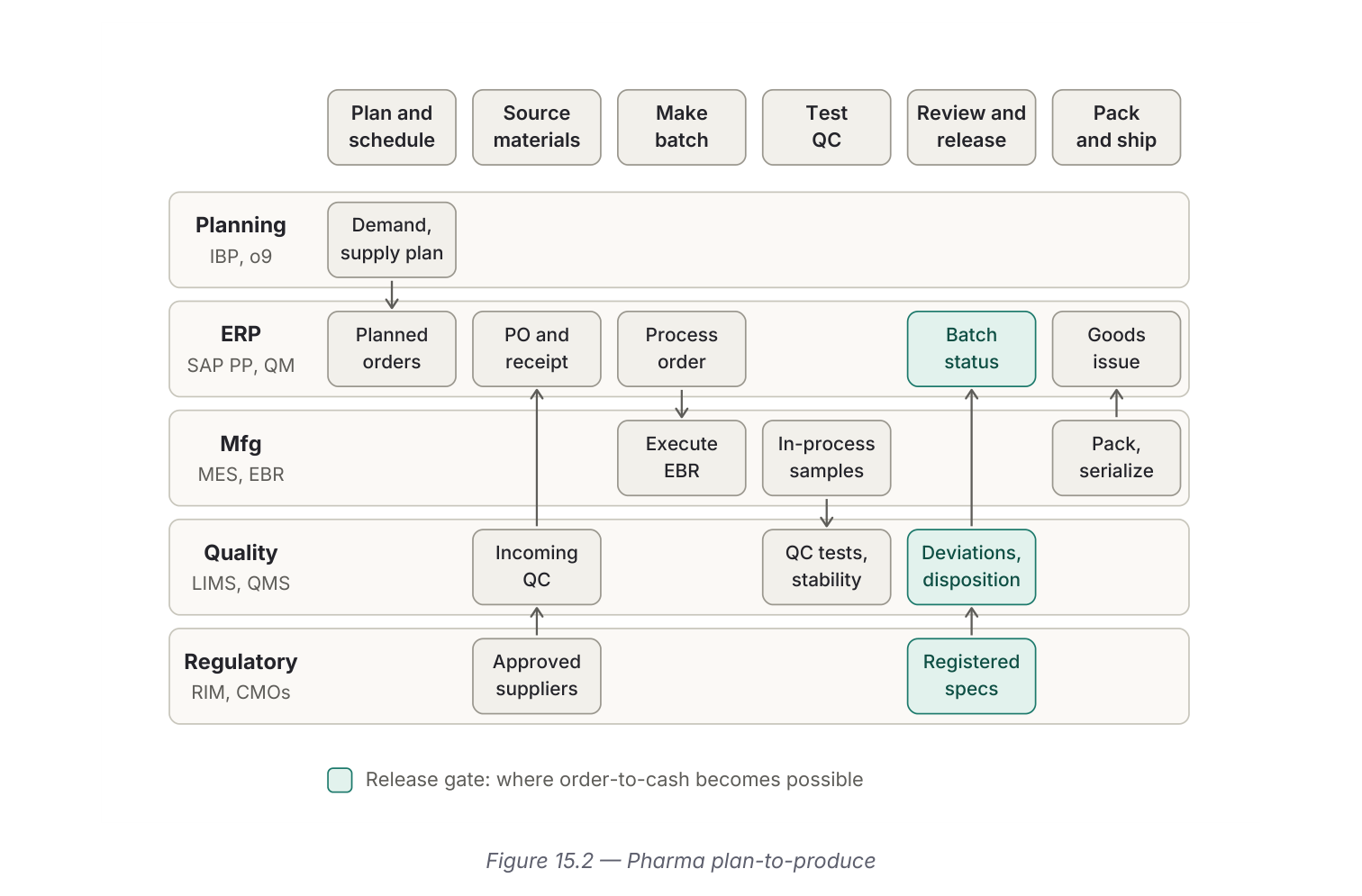
In order-to-cash, the hard knowledge sat in gross-to-net. In plan-to-produce it sits in release: the decision that allows a batch to become sellable, which legally belongs to named people in Quality.

| Stage | Key decision | Where meaning shifts |
|---|---|---|
| Plan and schedule | Commit the supply plan | Patient demand, batches and process orders are different units |
| Source materials | Accept a lot; qualify a supplier | "Received" is not "usable" until the QC decision |
| Make batch | Continue, adjust or stop | Recipe versions in MES, ERP and the registered process |
| Test (QC) | Accept results; investigate OOS | Passing is not releasable |
| Review and release | Disposition the batch, per market | "Released" has at least four meanings |
| Pack and ship | Pack for a market; release to distribution | Serial, batch and expiry travel into order-to-cash |
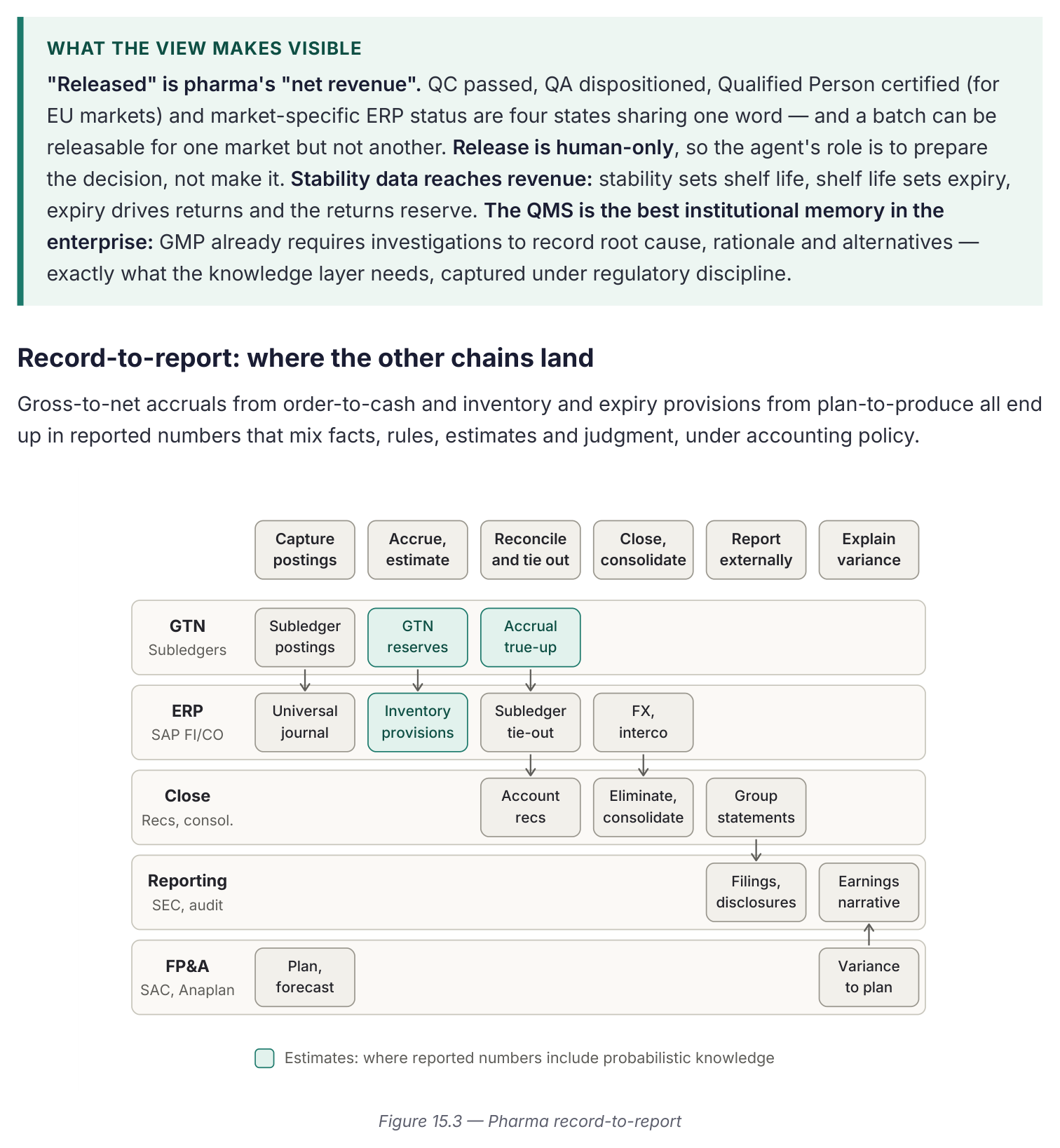
"Released" is pharma's "net revenue". QC passed, QA dispositioned, Qualified Person certified (for EU markets) and market-specific ERP status are four states sharing one word — and a batch can be releasable for one market but not another. Release is human-only, so the agent's role is to prepare the decision, not make it. Stability data reaches revenue: stability sets shelf life, shelf life sets expiry, expiry drives returns and the returns reserve. The QMS is the best institutional memory in the enterprise: GMP already requires investigations to record root cause, rationale and alternatives — exactly what the knowledge layer needs, captured under regulatory discipline.
Gross-to-net accruals from order-to-cash and inventory and expiry provisions from plan-to-produce all end up in reported numbers that mix facts, rules, estimates and judgment, under accounting policy.

| Stage | Key decision | Where meaning shifts |
|---|---|---|
| Capture | Accept postings | Subledger timing is not GL period |
| Accrue and estimate | Set reserves; apply overlays | The reported figure becomes part estimate |
| Reconcile | Investigate differences; book true-ups | Accrued, paid, claimed and disputed differ |
| Close and consolidate | Approve eliminations, FX, intercompany | Legal-entity view versus management view |
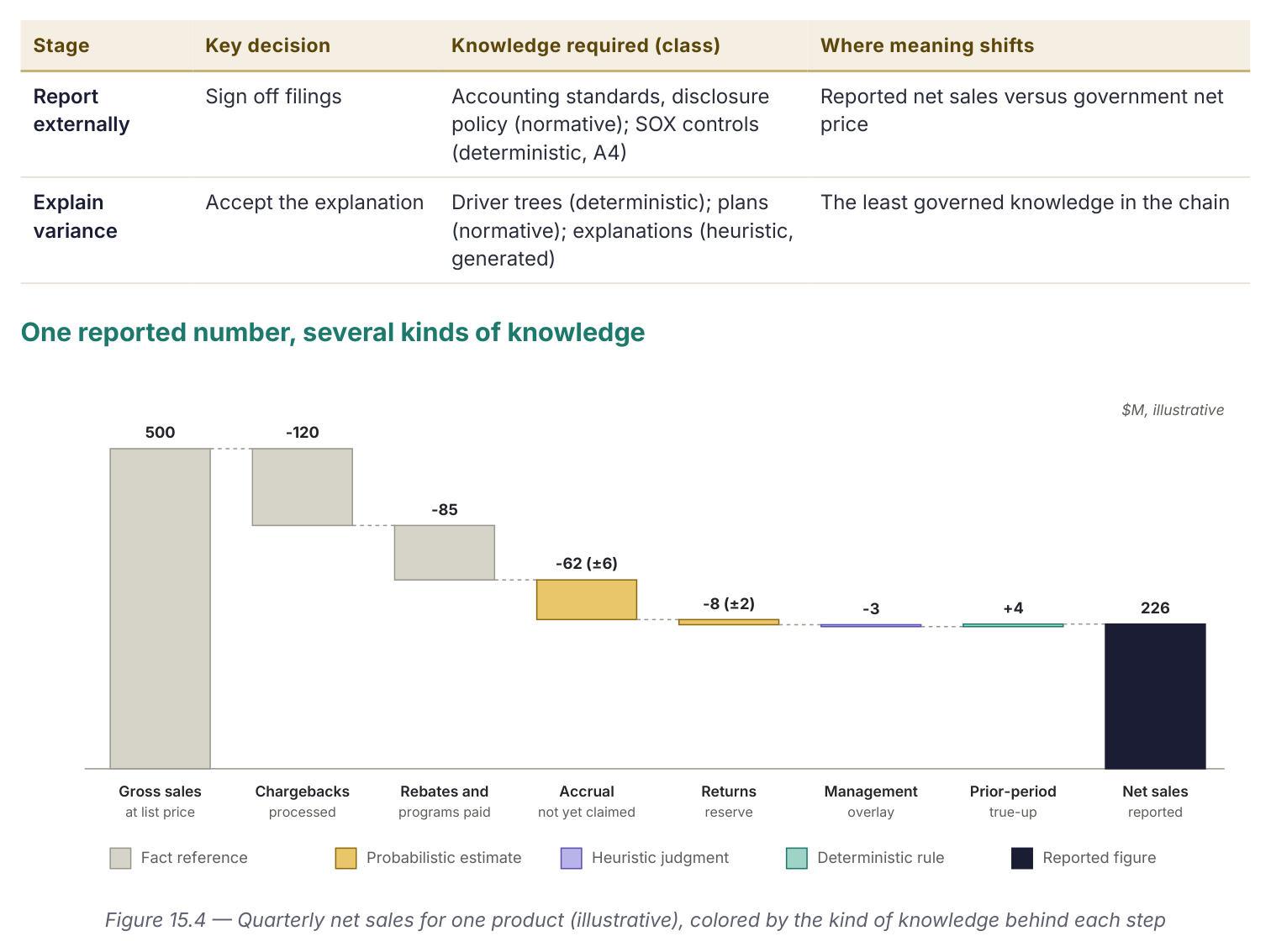
| Report externally | Sign off filings | Reported net sales versus government net price |
| Explain variance | Accept the explanation | The least governed knowledge in the chain |

| Quarterly net sales, one product (illustrative) | $M | Class · origin · assurance |
|---|---|---|
| Gross sales at list price | 500.0 | Fact reference · ERP · A1 reconciled |
| Chargebacks processed | −120.0 | Fact reference · GTN system · A1 |
| Rebates and government programs paid | −85.0 | Fact reference · GTN system · A1 |
| Accrual for claims not yet received | −62.0 (±6) | Probabilistic · machine-derived · A4 SOX-validated model |
| Returns reserve | −8.0 (±2) | Probabilistic · machine-derived · A4, under returns policy |
| Management overlay | −3.0 | Heuristic · human-authored · A3, rationale recorded |
| Prior-period true-up | +4.0 | Fact reference plus deterministic true-up rule |
| Reported net sales | 226.0 | About a third of the figure rests on estimates and judgment |
Record-to-report grades probabilistic knowledge: every true-up compares an accrual with what was actually claimed — the calibration evidence for the gross-to-net models. "Net price" is the seven-revenues problem under regulation: reported net sales and government-defined prices come from the same transactions under different legal definitions. Variance explanations are the weakest knowledge in the chain and the most likely to be laundered into fact. Origin tracking matters for disclosure: AI-drafted narrative carries its origin permanently, so disclosure controls can require named human authorship.
| From | To | Knowledge carried |
|---|---|---|
| Plan-to-produce: batch status per market | Order-to-cash: allocation, goods issue | Which batches are sellable, and where |
| Plan-to-produce: serial numbers, expiry | Order-to-cash: verification, returns | Product identity and time-bound saleability |
| Order-to-cash: chargebacks, rebates, claims | Record-to-report: postings, true-ups | Facts, and calibration evidence for accrual models |
| Order-to-cash: accrual models | Record-to-report: reserves | Probabilistic knowledge at A4 |
| Plan-to-produce: stability, write-offs | Record-to-report: returns reserve, inventory valuation | Quality decisions as financial facts and estimates |
These dependency chains — stability to expiry to returns reserve to reported revenue — are invisible in any single system. They become visible only when knowledge objects carry their relations.
A wedge is defined by a decision, not a capability. Each tests a different part of the model; together they cover every epistemic class, every governance tier and all three value chains.
| Wedge | Value chain | Agent autonomy | Governance tier | What it tests hardest |
|---|---|---|---|---|
| Chargeback validation | Order-to-cash | Human approval on exceptions | Standard and regulated | Bitemporal facts, MDM, external sources, rules versus agents |
| Batch record review by exception | Plan-to-produce | Human-only decision | GxP-validated | Deterministic critical path, validation, market-specific release |
| Gross-to-net reserve review | Record-to-report | Human-only approval | Regulated (SOX) | The full epistemic profile on one reported figure |
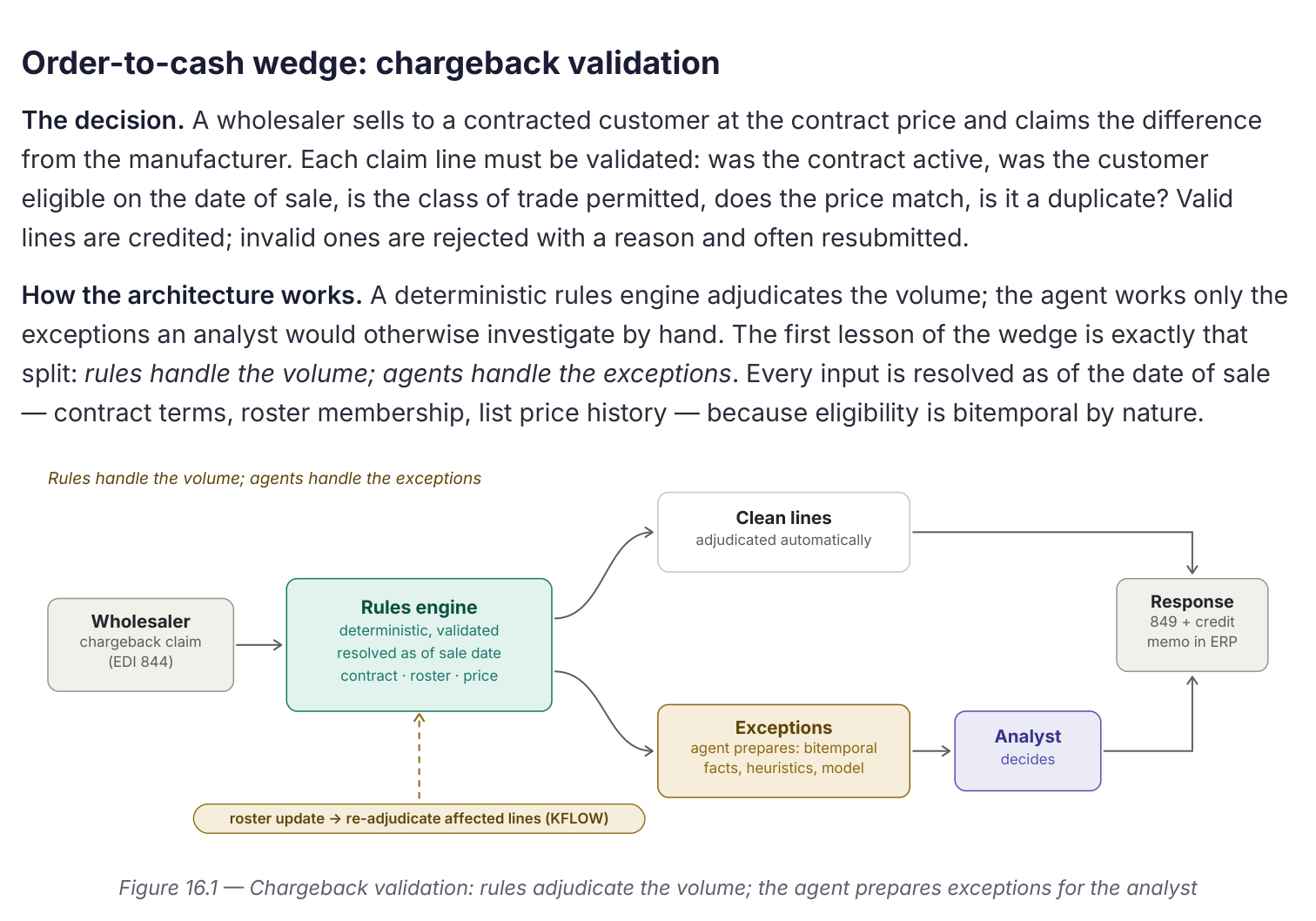
The decision. A wholesaler sells to a contracted customer at the contract price and claims the difference from the manufacturer. Each claim line must be validated: was the contract active, was the customer eligible on the date of sale, is the class of trade permitted, does the price match, is it a duplicate? Valid lines are credited; invalid ones are rejected with a reason and often resubmitted.
How the architecture works. A deterministic rules engine adjudicates the volume; the agent works only the exceptions an analyst would otherwise investigate by hand. The first lesson of the wedge is exactly that split: rules handle the volume; agents handle the exceptions. Every input is resolved as of the date of sale — contract terms, roster membership, list price history — because eligibility is bitemporal by nature.

What the analyst sees:
What it teaches. Without valid time and record time, this line is rejected, resubmitted and reprocessed. External rosters rarely arrive with effective dates, so valid time often has to be inferred and flagged. Customer identifiers disagree across systems, so MDM gaps surface immediately. And nobody internally owns the accuracy of a GPO feed until the architecture requires a named steward.
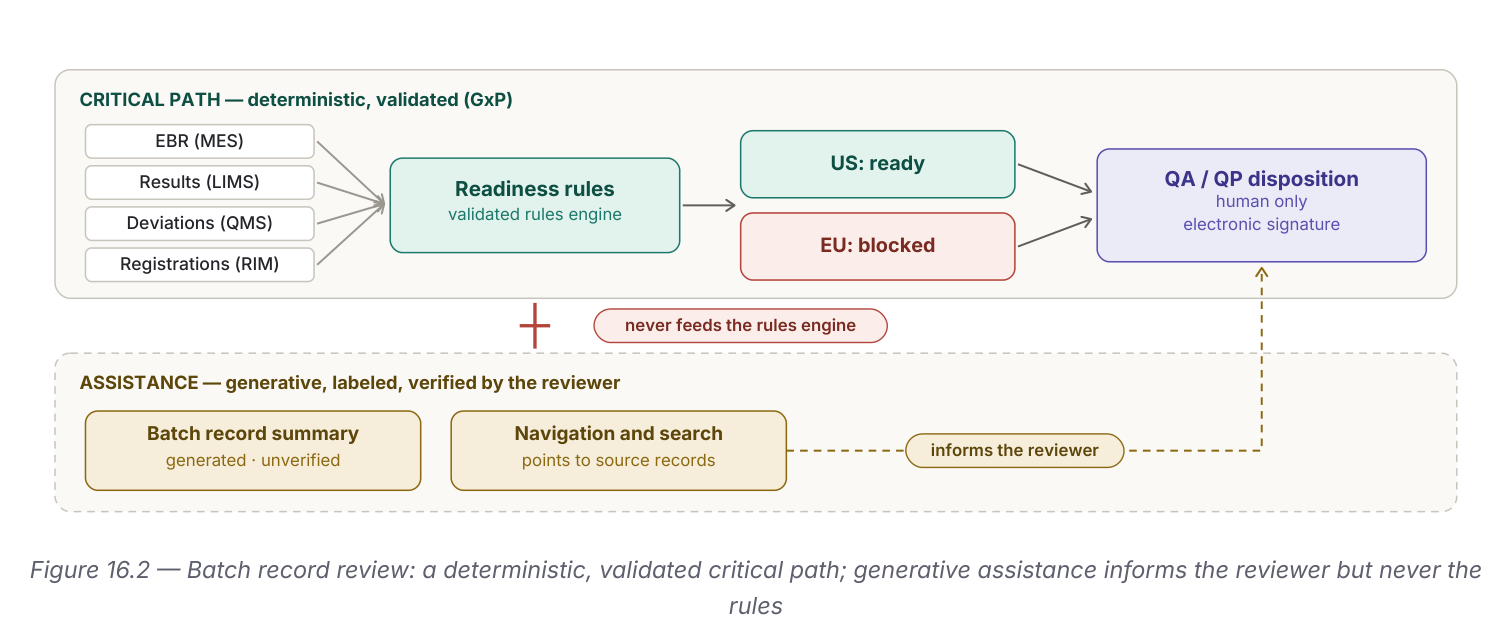
The decision. QA dispositions each batch, market by market; for EU markets a Qualified Person certifies it. Batch record review is often one of the slowest steps between the end of manufacturing and a sellable batch.
The regulatory context. EU GMP Annex 22 on artificial intelligence remains a draft under revision; its consultation draft limited critical GMP use to models with deterministic outputs and excluded generative AI from critical applications, while EMA works on an approach to generative AI. In April 2026, FDA issued what has been reported as the first warning letter citing improper reliance on AI in drug manufacturing, concerning AI agents that generated specifications, procedures and master production records without adequate quality-unit review (Appendix E). The recipient was a small manufacturer of homeopathic drug products with broad, basic GMP failings — not a large-pharma precedent — but the principle it restates holds: AI-generated GMP documents must be reviewed and approved by the quality unit.
1. The critical path is deterministic. Release readiness is evaluated in a validated rules engine; the language model never decides whether a criterion is met. 2. Generative output is assistance only — labeled, non-critical, and verified against source by the reviewer. 3. Agents never author GxP records. Specifications, procedures and batch records stay in their validated systems; a knowledge object references the validated record and is never its copy or its source of truth.

What it teaches. The most important measure is the missed-exception rate: an extra flag costs minutes, a missed one is a compliance failure. Validation of the agent, its prompts and its knowledge objects is the largest effort. Registered specifications are often documents, so extracting them into typed knowledge is itself a process to validate. And reviewers may over-trust a readiness summary, so procedures must require source verification of flagged and sampled items.
The decision. The controller approves gross-to-net and returns reserves at each close. They are among the largest estimates in a pharma company's reported revenue and a standing focus of auditors.
How the architecture works. The agent prepares the review: a reserve roll-forward, accruals versus claims actually received by program, model calibration status, proposed overlays with their rationale, and the decomposed net-sales figure from Chapter 15 with every line labeled. Probabilistic knowledge must be SOX-validated (A4); overlays must be human-validated (A3) with rationale captured at the time.
What it teaches. Labels are lost wherever spreadsheets sit between the gross-to-net system and the close; those spreadsheets become sources or are retired. Past overlays rarely have recorded rationale, so the first run creates an institutional-memory backlog. Accrual models may lack formal validation evidence, so reaching A4 is a project in itself. And this wedge closes the loop on chargeback validation, which produces the facts that grade the accrual model reviewed here.
Governance that has authority, regulation that is designed in, and a start that serves decisions before it builds platforms
Ownership without authority is governance theatre. Authority without capacity is a bottleneck. The operating model has to provide both.
The guidebook's sixth move was to govern meaning, not data. The knowledge layer makes that concrete through four governance tiers and one rule about authority: every owner can change the state of the objects they own without escalation, within the deadlines set by their domain council. Councils are small and domain-specific — gross-to-net, quality, finance — and decide within weeks, not quarters. A single heavy process for everything is how governance becomes theatre, and KMONITOR watches for the early signs: overloaded owners, ageing backlogs and recurring overrides.
| Role | Owns |
|---|---|
| Knowledge architect | KDEFINE, the concept spine, KLOAD contextualization rules |
| Decision intelligence designer | Decision objects, driver trees, KQUERY templates for each decision |
| Intelligence quality steward | Validation gates, golden questions, hypothesis verification |
| Agent platform lead | The agent runtime as a product: context assembly rules, guardrails, model selection, action gateway |
| Domain owners and councils | The meaning, rules and policies of their domain; approval within deadlines |
| Source stewards | The accuracy, timeliness and license terms of each source — including external feeds the enterprise does not control |
| Validation lead | Computerized-system validation for agents and knowledge in GxP processes |
| Regime | What it requires | Where the architecture answers |
|---|---|---|
| GxP | Validated systems; controlled records; human accountability for release; scrutiny of AI in critical decisions | GxP-validated tier; deterministic critical path; agents never author GxP records; validation of agents, prompts and knowledge as one system |
| SOX | Controls over reported numbers; evidence for estimates and management judgment | Regulated tier; A4 models and controls; overlay rationale captured as memory records |
| Government pricing | Legally defined price concepts; frequent rule changes | Separate definitional objects per legal definition; dual approval; short review cycles |
| Privacy and AI governance | Lawful processing; transparency; human oversight | Inherited entitlements; ethics boundary in KLOAD; origin tracking; human-only/human-approve autonomy levels |
Capturing institutional memory means capturing what people know and why they decided as they did. The architecture builds its answer into KLOAD rather than leaving it to policy: capture the reasoning, not the reasoner. Knowledge objects record what was decided, why, and what alternatives were considered. They do not record who disagreed, how long a decision took, or anything that functions as an individual performance measure.
Documents loaded into the knowledge layer can carry text designed to manipulate the agents that later read it. The architecture treats every extracted passage as data, never as instruction; strips or flags instruction-like content; carries each source's trust tier into every answer; and never lets document-derived knowledge drive an action on its own.
Do not launch a platform. Launch three decisions, and build only what they need.
The guidebook warned that another platform modernization would be the fourth repetition of the same mistake. The knowledge layer is especially exposed to that mistake, because "load all our knowledge" sounds like progress. Our recommendation is the opposite: start from decisions, and let the knowledge layer grow outward from decisions that work.
| Start with three decisions | One per value chain, chosen through the Decision Intelligence Audit: one where failure costs money visibly, one that gives influential skeptics time back, one that crosses a boundary no current system bridges. |
| Define before you load | Declare only the knowledge types those decisions need. Seed around fifty concepts by hand so that automated loading has something to resolve against. |
| Load narrowly | Connect the sources the decisions need. Resist the request to index every repository; it produces a knowledge swamp. |
| Sequence by regulatory burden | In pharma: chargeback validation first, gross-to-net reserve review second (it uses the facts the first produces), batch record review last — but begin its validation planning on day one. |
| Gate every go-live | Golden questions pass; every claim carries its labels; every knowledge object has an owner and the required assurance; every external source has a steward; reviewers are trained; the manual process remains until the wedge beats it. |
| Measure decisions | Dispute rates, release cycle time, close days, true-up variance, audit adjustments — not active users. |

The first runs of KLOAD will surface conflicts — policies that disagree with system configuration, definitions that disagree across functions — and gaps: rules without owners, overlays without rationale, customizations nobody can explain. This is not a sign that the architecture is failing. It is the first time the organization has seen its knowledge clearly. The conflict and gap backlog is the governance agenda for the second year, and the most persuasive evidence a sponsor will see that the work is worth doing.
Scope creep into a platform. The pressure to load everything comes early; the decision-first rule is the defense. Domain-expert time. Gross-to-net, QA and the controller's team are also running the close and releasing batches; their time must be planned, not hoped for. Validation running late. If the GxP wedge slips, the other two still deliver; that is why it comes last.
The question is not whether an organization's agents can answer. It is whether the organization could stand behind the answer — and show how it knows.
The guidebook ended with a hopeful observation: sediment can be excavated. This point of view describes what to build from what is excavated. Not a larger store, a faster pipeline or a better chatbot, but a layer of knowledge that is typed, owned, governed, versioned and lifecycled — and labeled, claim by claim, with what kind of knowledge it is, who wrote it, who has vouched for it, and how far it may be trusted.
The technology to build it exists. Models can extract, classify and reason; graphs, rules engines and registries can store and execute; vendors are converging on ways to exchange meaning. What no technology supplies is the organization's own knowledge and the discipline to keep it honest. That work is unglamorous. It means naming owners, writing down rationale, separating what was intended from what was implemented, and refusing to let an estimate be presented as a fact.
In regulated industries, that discipline is not optional. A release decision, a reported revenue figure and a chargeback credit each carry legal weight. Agents will increasingly prepare all three. The organizations that benefit will be those whose agents can say, for every claim, what it rests on — and those that do not will discover that confident, fluent and wrong is the most expensive combination in enterprise technology.
Reference material for architects, governance teams and anyone implementing against this model
| Term | Meaning |
|---|---|
| Answer contract | The fixed structure of every claim returned by KQUERY: value, class, origin, assurance, versions, provenance, scope, as-of time, confidence, treatment and caveats. |
| Assurance | Who has checked a knowledge object, how, and whether the check is current: A0 unverified to A4 formally validated. Assurance expires. |
| Bitemporal | Recording both valid time (when something applied to the business) and record time (when the organization knew it). |
| Context | The runtime bundle assembled for one request. Never stored as a layer; persisted only as a context manifest. |
| Context manifest | The record of which knowledge objects, versions, facts, scope and entitlements produced an answer. |
| Decision-first | The rule that every knowledge object must serve at least one decision, and that queries start from the decision. |
| Epistemic class | One of six kinds of knowledge: definitional, deterministic, normative, probabilistic, heuristic, generated. |
| Epistemic profile | Class, origin, assurance and derived treatment, carried by every knowledge object. |
| Fact reference | A pointer to a record in a system of record, with as-of time and quality signal. Not a knowledge class. |
| Harness | Everything around a model that makes an agent useful for one purpose: instructions, retrieval index, tools, guardrails, evaluation set and memory. |
| Intended / implemented | Whether a deterministic rule is owner-approved policy or the behavior a system actually enforces. |
| KDEFINE, KLOAD, KSTORE, KQUERY, KFLOW, KMONITOR | The six components: define, extract-contextualize-load, store, query, govern and move, monitor. |
| Knowledge object (KO) | A governed unit of knowledge with an envelope and epistemic profile. |
| Memory record | A record of a specific decision or action with its rationale and alternatives. |
| Model boundary | The runtime rule that models supply language and reasoning, while enterprise claims must be grounded in governed knowledge. |
| Origin | Who or what authored a version: human, system, machine, AI, or AI-drafted and human-edited. Fixed per version. |
| Parametric bypass | A model answering from its training instead of governed knowledge. |
| Shadow context layer | The definitions, rules and context hidden in agent prompts, private indexes and guardrails. |
| Siloed Agent | A purpose-built agent whose knowledge lives inside its own harness rather than in a shared, governed knowledge layer. |
| Treatment | How an agent must use a knowledge object, derived from class, origin and assurance; may be tightened, never loosened. |
| Trust tier | A source's tier, which caps the assurance knowledge derived from it alone can reach. |
| Wedge | A bounded deployment defined by one decision, proving the architecture end to end. |
| 340B | US drug pricing program for eligible covered entities | MCP | Model Context Protocol |
| AMP | Average manufacturer price (Medicaid) | MDM | Master data management |
| ASC 606 | US revenue recognition standard | MES | Manufacturing execution system |
| ATTP | SAP Advanced Track and Trace for Pharmaceuticals | MLR | Medical, legal and regulatory review |
| CLM | Contract lifecycle management | NBRx | New-to-brand prescriptions |
| CRM | Customer relationship management | QA / QC | Quality assurance / quality control |
| EBR | Electronic batch record | QMS | Quality management system |
| EDI 844 / 849 | Electronic chargeback claim / response | QP | Qualified Person (EU batch certification) |
| ERP | Enterprise resource planning | RIM | Regulatory information management |
| GMP / GxP | Good manufacturing / good practice regulations | SOX | Sarbanes-Oxley Act |
| GPO | Group purchasing organization | TRx | Total prescriptions |
| GTN | Gross-to-net | WAC | Wholesale acquisition cost (list price) |
| HCP | Healthcare professional | IDN | Integrated delivery network |
| IBP | Integrated business planning | LIMS | Laboratory information management system |
| Decision | What we chose |
|---|---|
| Data–knowledge boundary | Data stays in systems of record; knowledge references it and never copies it |
| Classes | Six epistemic classes; definitional and deterministic separate; fact references outside the classes |
| Epistemic profile | Class, origin, assurance and derived treatment on every knowledge object |
| Origin | Fixed per version; approval raises assurance, never changes origin |
| Composite confidence | Per-claim confidence always; a single figure only from a validated composite model, never on a GxP critical path |
| Automatic validation | Only reconciled fact references and implemented rules read from configuration, below the GxP tier |
| Context | A runtime function, persisted only as a manifest |
| MDM | Golden records are data; match, merge and survivorship rules are knowledge |
| Insights | A separate insight store; promotion into knowledge creates proposed objects |
| External sources | Every source registered with a named internal steward and defined behavior when stale |
| Existing agents | Keep the agents, move the knowledge: harvest harnesses into the shared layer and re-point agents to it |
| Vendors | Publish governed definitions into vendor semantic layers; embedded agents consume enterprise knowledge or declare limits |
| AI in GxP | Deterministic critical path; generative output as verified assistance; agents never author GxP records |
| Net price | Reported net sales and each government-defined price are separate regulated definitions |
| Names | KDEFINE, KLOAD, KSTORE, KQUERY, KFLOW, KMONITOR — chosen to avoid collisions with established technologies |
| Class | Types | Examples in this document |
|---|---|---|
| Definitional | concept, metric_definition, decision | Net sales under ASC 606; batch release status; chargeback validation decision |
| Deterministic | driver_tree, process_model, handoff, control, action | Reserve roll-forward; release readiness rules; eligibility rules |
| Normative | policy, target, contract_term, sla | Estimation policy; contract terms; registered specifications |
| Probabilistic | model, forecast_reference, composite_model | Accrual models; returns reserve model; recurrence model |
| Heuristic | playbook_rule, pattern, expert_annotation | Roster-lag rule; reviewer checklist; controller's overlay |
| Generated | hypothesis, explanation, summary | Dispute-cause explanation; batch record summary |
| Fact references | fact_reference | List-price history; roster membership |
| Records | memory_record | Reserve approval with rationale |
| Infrastructure | source | GPO roster feed; 340B list; ERP instance |
| Knowledge element | Standard |
|---|---|
| Concepts, variants, broader/narrower terms | SKOS |
| Type schemas and constraints | OWL and SHACL |
| Metric, semantic-model and ontology definitions | Apache Ossie (incubating), successor to Open Semantic Interchange |
| Process models | BPMN |
| Decision logic and controls | DMN |
| Provenance | PROV-O |
| Flow lineage for loads and lifecycle runs | OpenLineage |
| Agent access to knowledge tools | Model Context Protocol (MCP) or equivalent |
| Bitemporal lifecycle, epistemic class, origin, assurance, treatment | No adequate standard — defined in KDEFINE |
Regulatory and vendor statements reflect these public sources as of October 2026. Both areas are changing quickly; verify current status before relying on them.
Agent Adda — Data and Analytics Practices. From Data to Intelligence: The 30-Year Reckoning and the Road Ahead. 2026 edition.
Agent Adda — Data and Analytics Practices. Documents Are Not Knowledge: The Case for Purpose-Built AI Knowledge Layers. 10 March 2026.
Health Products Regulatory Authority (HPRA), QP Forum 2026 presentation on EU GMP Annex 22 status. IntuitionLabs, "EU GMP Annex 22: AI compliance in pharma." PharmOut, "EMA 2026–2028 GMP work plan." DLA Piper, "FDA warning letter highlights risks of using AI in drug manufacturing," April 2026. Regulatory Affairs Professionals Society, "FDA warns firm for inappropriate use of AI in drug manufacturing." U.S. FDA, Warning Letter 320-26-58 to Purolea Cosmetics Lab, 2 April 2026. BioSpace, "FDA's first AI-focused cGMP warning letter signals new scrutiny for manufacturers."
Financial Accounting Standards Board, ASC 606. Centers for Medicare & Medicaid Services, Medicaid Drug Rebate Program; Open Payments. Health Resources and Services Administration, 340B Drug Pricing Program. U.S. CFR, 21 CFR Part 11; Parts 210–211. European Commission, EudraLex Volume 4 (Annex 11, Annex 16).
Snowflake, "Open Semantic Interchange specifications finalized." dbt Labs, "The OSI spec updates" and "OSI is now Apache Ossie (Incubating)," July 2026. Apache Ossie (incubating), incubator.apache.org. The Information, "Microsoft reverses course on AI data standards group," 29 September 2026. BARC, "SAP data and analytics 2026: from roadmap to reality." DBTA, "SAP enhances copilot Joule with collaborative AI capabilities."
This point of view stops at the boundary between what to build and why and how to build it with which products. The specifications below give architects enough to begin design; technology selection, sizing and cost depend on each organization's estate and are deliberately left out.
| Capability area | Approach | Reasoning |
|---|---|---|
| Knowledge content | Build | Definitions, rules, policies, heuristics and rationale are the organization's own; they cannot be bought |
| KDEFINE policy | Build on standards | Types compile to SKOS, OWL/SHACL, BPMN, DMN; epistemic profile and lifecycle policy are specific to this model |
| Graph, rules engine, model registry, vector index | Buy | Mature product categories; KSTORE is a logical layer over them |
| Metric execution and exchange | Buy and publish | Use a metric layer; exchange definitions through Apache Ossie where vendors support it |
| Lineage and provenance capture | Buy | Lineage platforms and OpenLineage-compatible tooling |
| KLOAD extraction | Configure | Language-model and document-extraction services, configured with typed schemas and safeguards |
| KFLOW workflows | Configure | Existing workflow, QMS change-control and ticketing tools, so governance happens where work already happens |
| KQUERY and the answer contract | Build | The decision-first routing and labeling are the core of the model |
| Agent runtime | Configure | Orchestration frameworks and foundation-model APIs, with grounding, treatment checks and the action gateway added |
| KMONITOR | Configure and build | Observability and evaluation tools, plus decision-level and governance measures that no tool provides |
| Latency | Executing rules and resolving facts at query time costs time. Cache definitional and deterministic knowledge by version; never cache facts as knowledge. |
| Scale | KSTORE holds thousands to hundreds of thousands of objects, not billions of rows. Volume pressure falls on fact resolution, the insight store and audit logs. |
| Availability | When a source or engine is unavailable, the runtime must degrade visibly — say what cannot be answered — rather than fall back on model memory. |
| Multi-instance and federation | Global concepts, decisions and policies; per-instance process models and controls; domain stacks sharing one semantic spine. |
| Validation footprint | In GxP scope, the agent, its prompts, its knowledge objects and the rules engine are validated as one system; keep the GxP footprint as small as the decision allows. |
| Out of scope | Product selection, sizing, cost estimation and detailed security architecture. These depend on the organization's estate and are best done in design, not in a point of view. |